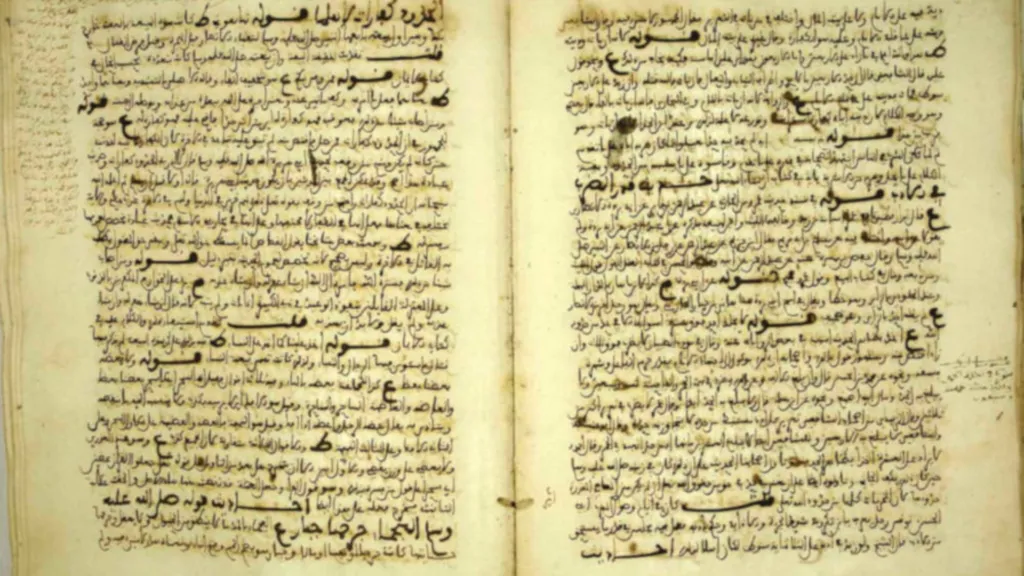
Definition and Function of Hadith
The word
hadith means “communication, narration” in the most general sense
1. It can refer in common language to any event that happened in the past. In Islam, this word has taken on the specific meaning of an oral communication, a speech attributed to the Prophet, known as a prophetic tradition [hadith]. Every hadith consists of two parts: the text of the hadith, that is, the reported speech or event (in Arabic:
matn); this is preceded by a chain of transmission (
isnad) believed to contain the names of the various narrators who have successively transmitted the prophetic speech. In its most common form, the
isnad is presented as follows: “Such-and-such reported that such-and-such reported that such-and-such […] that the Prophet said: […]”.
It is likely that the use of transmission chains originates from Rabbinic Judaism, as noted by historian Joseph Horovitz, who points out the existence in the Talmud of a very similar system through which rabbis transmitted a given tradition
2. For example, from the Babylonian Talmud: “Rabbi Zeria said: Rabbi Ammi said: Rabbi Simeon ben Laqish said: […]” (
Bava Metzia 59b. 1); “Rabbi Abba said: Rabbi Hiyya bar Ashi said: Rava said: […]” (
Niddah 16b. 19), etc. This hypothesis was reaffirmed more recently by Michael Cook and Gregor Schoeler, who emphasize that by the time transmission chains came into use among Muslims, “there already must have been enough converts from Judaism who knew the system of authentication of the Mishnah – definitively written down in the meantime – and could introduce it into Islamic tradition”
3.
Most hadiths are doctrinal and legal teachings that serve as a kind of guide for the behavior of believers. For example, the main collection of hadiths among Sunnis, the famous Sahih of al-Bukhari (d. 870), consists of 97 chapters each addressing a particular issue related to beliefs, good manners, or religious practices: “ablutions,” “night prayer,” “almsgiving,” “interpretation of dreams,” etc. Every aspect of Muslims’ religious and secular life, even the most trivial, is codified by the hadiths. Some prophetic traditions even specify the best practices regarding greeting, eating, and even wiping after using the restroom.
Hadiths serve the function of
exemplum, that is, a model to follow and imitate. From a legal standpoint, they constitute the second source of Islamic law after the Qur'an, and even the primary source in terms of quantity. The divine voice of the Qur'an proclaims, “We have not omitted anything in this Book” (6:38), yet it remains silent on many aspects of the believer’s life. Regarding prayer, for example, the Qur'an provides almost no information despite its religious importance. Relying solely on the Qur'an, it would be impossible to know ritual formulas to utter, the number of repetitions, gestures to perform, the manner of performing ablutions, etc. It is only in later collections of hadith that directives are defined, allowing the establishment of *orthopraxy* (from Greek
ρθοπραγία, “right conduct”). Hadiths thus aim to fill the silences of the Qur'an by indicating the best practices to follow, where the “Book of Allah” at best offers scant indications.
Hadith and Sunna
This religious orthopraxy derives from the “Sunna
of the Prophet.” The Sunna encompasses the words and actions attributed to Muhammad. It refers to the “exemplary practices” of the Prophet that should be imitated. In other words, the Sunna represents the way of life, the normative standard within the Muslim community, believed to date back to the time of Muhammad and the Companions. The concept of
sunna is inherited from the pre-Islamic era, where it referred to “the traditions of the Arab world, customs, and habits of the ancestors” among the pagan tribes
4. However, it has been demonstrated that in the early days of Islam,
sunna did not have a direct relation to the Prophet. In Islamic jurisprudence texts, the term originally related to the “living tradition,” i.e., the laws in use within Muslim communities, often inherited from Jewish or Roman customary law
5.
In early Islam, references to the Prophet’s example were rare. The legal basis used to establish law or good religious practices was the opinion of early Muslim jurists, sometimes traced back to Muhammad’s Companions to give it a firmer foundation. An example is found in the Medinan jurist Malik b. Anas’s (d. 795) legal treatise
Al-Muwatta, where he defines “
sunna” as the legal practices in force in Medina
6. However, these practices were not justified by prophetic traditions but were the personal opinions of jurists. This is essentially the criticism that the jurist al-Shafi’i (d. 820) directed at the Medinan scholars, who, according to him, based their practices on local opinions “rather than on a tradition from the Prophet”
7. In other words, it is necessary to disconnect “
sunna” and Hadith, at least for the first century of Islam or longer
8. It was only under the influence of al-Shafi’i that
sunna would come to designate the Prophet’s exemplary practices as reported in the hadiths
9.
The invention of the “Sunna of the Prophet” marked a decisive step for the development of hadiths, which now serve as a source of Islamic law. Officially, the “Book of Allah” remains the primary source of law for jurists. In practice, however, the prophetic Sunna has often been favored over Qur'anic provisions, to the point that it was declared that “the Sunna
is the judge of the Qur'an, and the Qur'an is not the judge of the Sunna” (
As-Sunnah qāḍiyah ‘ala al-qur’ān wa-laysa al-qur’ān bi-qādin ‘ala as-sunnah)
10. One example is the legal punishment for adultery. The Qur'an states that the guilty should receive a hundred whippings, whereas hadiths prescribe stoning, which was ultimately unanimously adopted by the Islamic legal schools
11.
A Later Phenomenon
It is in this context that the earliest collections of hadiths appeared. Among Sunnis, the six major collections (
al-kutub al-sitta) are generally relied upon, compiled by al-Bukhari, Muslim ibn al-Hajjaj (d. 875), an-Nasa'i (d. 916), Abu Dawi (d. 889), an-Tirmidhi (d. 893), and Ibn Majah (d. 887). An important detail immediately draws attention: the authors listed all lived in the 9th century, about two hundred years after Muhammad's death. There are some earlier hadith collections, but they are less extensive and their authenticity is not always established
12. Nonetheless, it is an undisputed fact that hadiths were collected and fixed in their material form at least a hundred years after the Prophet’s passing, and even more so for the most “authentic” books in the eyes of Muslims. The Hadith is therefore a
late phenomenon. One factor explaining why it took some time before the prophetic traditions were written down is the opposition to writing among the early Muslim authors. At least until the late 8th century, oral transmission was the dominant mode, and writing was banned or even actively opposed. This opposition may go back to the Prophet himself, who supposedly said: “Do not write down my sayings except the Qur'an; and whoever has written something other than the Qur'an, let him destroy it!”
13. At most, some authors would take notes for personal use, which they would destroy before dying
14. Cook has demonstrated that opposition to writing in early Islam is a legacy of Rabbinic Judaism, which also had a similar prohibition
15.
The Question of Authenticity
The two hundred years or so between the main hadith collections and the death of Muhammad naturally raised doubts among historians. The question arises whether the hadiths genuinely originate from the historical figure of the Prophet, or whether they were fabricated at a later date
16. To be honest, skepticism towards Hadith is not unique to modern historians. From the earliest days of Islam, some currents refused to use hadiths as a source of authority because of their distrust in their authenticity
17. The fabrication of hadiths is a well-attested and acknowledged phenomenon within Muslim sources themselves. The goal was to legitimize doctrinal, legal, or political viewpoints by attributing them to the Prophet through the Hadith
18. To grasp the extent of this phenomenon, note that al-Bukhari is said to have examined about 600,000 hadiths, selecting approximately 7,000 for his “authentic” collection – meaning he rejected 99% of them as false.
Muslim specialists of Hadith, called traditionists (
muhaddithun), developed a “science of hadith” (
‘ilm al-hadith) to evaluate the degree of authenticity of hadiths. Curiously, however, traditionists focused less on the
matn, that is, the text itself, and more on the chain of transmission. Even if the content of a hadith was anachronistic, incoherent, or absurd, it could not be rejected as long as its
narration chain was considered solid
19.
The strength of the
isnad is assessed based on several criteria. First, the transmission chain must be continuous, with no “gaps” between narrators. Then, the reliability of transmitters was determined using biographical notices that aimed to provide information about their integrity, piety, memory, etc. These are the broad outlines of the procedure. At the end of the assessment, the hadith was classified into one of the major categories: “forged” (
mawdu’), “weak” (
da’if), “good” (
hasan), or “authentic” (
sahih).
Are the methods used by Muslim traditionists to distinguish “authentic” hadiths from fabrications sufficiently robust? From an epistemological and historical standpoint, the answer is clearly no. Austrian oriental scholar Alfred von Kremer, one of the pioneers in studying hadiths with modern methods, described the traditionist evaluation system as “a very clumsy and poorly shaped weapon”
20. First, the notion of certainty is generally excluded in human sciences, especially when human memory and oral transmission are involved, which are far from trustworthy
21. Even eyewitness testimony is not as reliable as it seems
22. As Jonathan Brown points out, we remain within the realm of probability: “even the vast majority of
sahih Hadiths,” he writes, “were only probable in their attestation”
23. The consequence is that Islamic law was developed based on traditions that are at best
probably authentic, with varying degrees of uncertainty. This also means some Qur'anic provisions (and thus divine ones) have been abrogated by prophetic hadiths, about which residual doubt remains regarding their authenticity.
Historians have highlighted other issues concerning the question of hadith authenticity. The use of chains of transmission was only widely adopted quite late, toward the end of the 8th century. Previously, hadiths were often cited without
isnad, or if present, the chain did not reach back to the Prophet. Moreover, narration chains were manipulated in clear ways. For instance, when “filling in gaps” between narrators, their birth and death dates were sometimes altered to pretend they were contemporaries
24. The criteria for evaluating hadiths themselves were only established later, after the main collections were compiled, and biographical notices emerged only from the 9th century onward.
Furthermore, the criteria used for such evaluations are arbitrary, subjective, and inconsistent. How does one objectively assess a transmitter’s memory? Were memorization tests conducted? The same question applies to piety: what objective criteria measure a person's piety? And what justifies assuming a transmitter is more reliable simply because he is pious? The most insurmountable problem is this: hypothetically, if the traditionist evaluation system could reliably determine the authenticity of narration chains, it does not solve the other issue—these chains themselves could be fabricated. A chain of transmission could seem “authentic” according to the criteria used, yet have been entirely manufactured. Once the methods for validating
isnad authenticity were known, forging a transmit chain became child's play—and even a profitable trade for some. Additionally, nothing prevented someone from “stealing” an authentic-sounding chain and attaching it to a fabricated hadith.
The question of hadith authenticity was thoroughly examined by Hungarian orientalist Ignaz Goldziher in his
Muhammedische Studien published in 1890
25. He concluded that the Hadith is a phenomenon of
retroflection. In other words, hadiths are the product of debates and needs (political, legal, dogmatic, etc.) of later Muslim communities that used the authority of the Prophet for their own purposes. Hadiths were mass-produced to serve specific needs, questions, to justify positions, oppose opponents, and so forth. Consequently, even the so-called “authentic” (
sahih) hadiths are not immune to fabrication. Goldziher noted that:
“Traditions will for us, not as historical documents of early Islam, but as witnesses to the tendencies that appeared within the Muslim community in the more advanced stages of the development of this religion”
26.
This quote significantly influenced Islamic studies. Following Goldziher, Joseph Schacht, whom we have already mentioned, reached similar conclusions in his work
The Origins of Muhammadan Jurisprudence. He demonstrated that the hadiths concerning legislation had been fabricated by the Islamic legal schools and attributed to the Prophet to support their own legal doctrines. The second and third centuries of Islam experienced a significant “inflation” of hadiths, paradoxically showing that the further removed from the Prophet’s time, the more numerous the hadiths became.
It is true that some positions advanced by Goldziher and Schacht have been modified or nuanced by subsequent research
27. Nonetheless, the core thesis—that hadiths largely reflect the communities of the subsequent centuries rather than authentic documents about the historical figure of the Prophet—is widely accepted today by most scholars. Daniel Brown emphasizes that “for many Hadith scholars, the probability that a given tradition can be reliably attributed to the Prophet is close to zero”
28. It is also argued that the late dating of many hadiths is overly generalizing, as Harald Motzki points out. Using a sophisticated method called isnād-
cum-matn analysis (known by the English acronym ICMA), they hypothesize that some hadiths appearing in later collections circulated already for some time. However, this does not mean that these traditions are authentic. As Motzki explains:
“I merely assume that many of the traditions appearing in existing compilations were not invented by the compilers, but they have a history (including falsifications) that can be traced back to a certain period. The main goal of my approach is to date the traditions. The fact that, for example, a hadith of the Prophet can be dated to the second half of the seventh century does not mean it is authentic in the sense that it genuinely originates from him […]. Dating traditions allows conclusions about this kind of authenticity only in very rare cases, or never”
29.
We cannot escape the conclusion that it is impossible to determine with certainty whether a hadith truly descends from the Prophet. At best, we can estimate its probability by applying certain criteria of authenticity (embarrassment criterion, multiple attestation, non-dissimilarity, etc.), which we will revisit in a future publication.
The Case of Hadith Qudsi
In its most classical form, a hadith is a speech attributed to Muhammad. However, there is a category of hadiths in which it is Allah—rather than the Prophet—who speaks directly. These are called hadith qudsî, which could be translated as “divine saying.” They typically begin with the phrase “Allah said.” This phenomenon is quite unusual because normally Allah’s speech is recorded in the Qur'an, not in hadiths. This suggests that early in Islam, there was some confusion between the Qur'an and Hadith. Alfred-Louis de Prémare notes:
“There was a period, whose temporal limits are difficult to determine, when the distinction between Hadith and Qur'an was not yet as clear and absolute as it became later—in which the Qur'an is the word of God and the Hadith is the word of Muhammad. In this distinction, we are, in fact, dealing with two terms that only later became technical, and we cannot project the modern understanding onto the primitive period of Islam without risking anachronism”
30.
In any case, hadith qudsî came to be considered an integral part of divine revelation, despite their exclusion from the Qur'an. For example, Ibn Hajar al-Haytami (d. 1566), a scholar of hadith, distinguished three categories: the Qur'an, previous revelations, and hadith qudsî
31. Of course, doubts about the authenticity of regular hadiths are equally valid for hadith qudsî—except that here, it is Allah’s words—and not just the Prophet’s—who are subject to possible falsification.
Hadith qudsî often consist of more or less faithful quotations of biblical writings, or even apocryphal books
32. An example is the saying found in collections of al-Bukhari, Muslim, and others: “Allah said: I have prepared for My righteous servants what the eye has not seen, nor the ear has heard, nor has it occurred to a human heart”
33. This hadith strongly resembles a phrase found in the First Epistle to the Corinthians, where Paul of Tarsus states: “But as it is written: Eye has not seen, nor ear heard, and what God has prepared for those who love Him” (1 Cor 2:9).