Context
The Quran recounts the scene of Abel's murder in these terms:
Tell the full truth of the story of the two sons of Adam: Each offered a sacrifice: the first's was accepted; the other's was not accepted. [Cain] then said: "I will kill you!" The first [Abel] replied: "God only accepts offerings from those who fear Him. If you raise your hand to kill me, I will not raise mine to kill you. I fear God, the Lord of the worlds" (5:27-28).
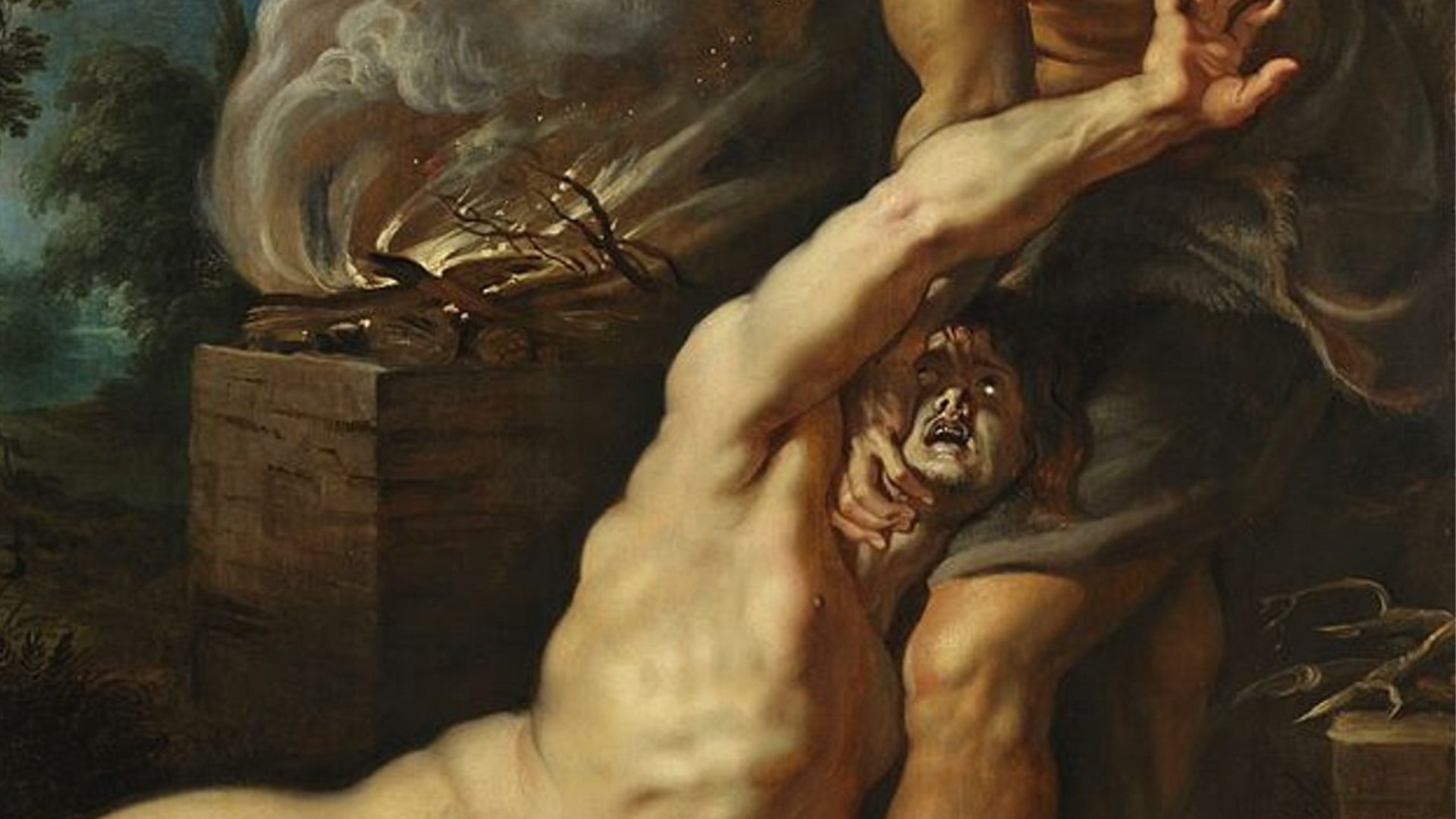
This passage retells the famous story from Genesis where Abel and Cain each make an offering to God. Since his brother’s offering was preferred over his, Cain became angry and killed him, motivated by the universal passion that is envy
1 . But the Qur'anic version of Abel's murder deviates somewhat from the biblical story. As we will see, the Quran primarily draws on Jewish and (especially) Christian commentaries of the story of Abel and Cain.
Why Did God Prefer Abel’s Offering
A first question posed to ancient authors was why God chose Abel’s offering rather than Cain’s. The biblical text gives no indication, which led Jewish and Christian commentators to speculate on the matter. One Jewish interpretation is as follows: God preferred Abel’s offering because he performed better deeds. In the Palestinian Targum (a paraphrased translation of the Torah into Aramaic), there is a dialogue where Abel explains to his brother: “Because
my actions were better than yours, my offering was accepted favorably, while yours was not accepted favorably”
2 . The author of the Quranic passage seems clearly inspired by this interpretation because he makes Abel say that “
God only accepts the offerings of those who fear Him,” which essentially states the same idea. The dependence of the Quran on the Targum is confirmed by the vocabulary analysis: the Quranic term used to mean that Allah “
accepted” Abel’s offering is tuqubbila, which resembles the Hebrew verb etqabbal. However, as historian Joseph Witztum has shown, this term is specifically found in the Targum, whereas Biblical Hebrew uses the verb minha
3 .
“I Will Kill You”
In the Quran, Cain clearly announces his intention to his brother and issues the following threat: “
I will kill you.” This detail is entirely absent from the Bible, where there is no dialogue between the two brothers, but Witztum has shown that the same expression is found in several Syriac texts from Cain. In a poem, for example, one reads: “Since the Lord took pleasure in your sacrifice but rejected mine,
I will kill you: because He favored you”
4 . Again, it is interesting to note the linguistic similarities between the two texts: the expression used in the Quran is la-aqtulannaka, which closely approximates the Syriac qâṭelnâ lâk. As Witztum notes, “although these words [...] are fairly common in both languages, their appearance in a similar group in both traditions suggests that the story was indeed transmitted through an Aramaic intermediary”
5
The Passivity of Abel
Another common point between the Quran and Syriac homilies is the passive attitude adopted by Abel. Instead of trying to defend himself, he tells his brother: “
I will not raise my hand to kill you.” This response is all the more curious since the Quran typically advocates the law of retaliation (2:178). But here, Abel appears as a willing victim, accepting the fate his brother has in store for him without showing the slightest sign of resistance. As Witztum remarks, the Syriac texts describe Abel similarly. In the Syriac Life of Abel, for example, he addresses his brother saying: “
Do what you have planned to do” (literally: “what is in your heart”), accepting his destiny without resistance. The question then arises as to why Christian authors (unlike Jewish commentators) chose to make Abel a passive figure who apparently willingly accepts being killed. To understand this, it is necessary to recall that Christians read the Old Testament typologically. Specifically, Christian exegetes see Old Testament characters as foreshadowings of Jesus. Thus, Abel in some way appears as the “prototype” of Jesus. Abel's sacrifice, which allows himself to be killed by his brother, anticipates and prefigures Jesus’ death, who will also accept his fate without resistance. This interpretive framework is explicitly stated in the Syriac Life of Abel, where we read: “How the symbols of our Lord were foreshadowed in the sacrifice of Abel!”
6 . The way the Quran presents Abel’s murder is therefore clearly inspired by Christian interpretations from the Syriac tradition. This suggests that the author(s) of the Quranic passage were familiar with Syriac traditions. It is even probable that we are dealing here with Christian scribes converted to the “Quranic community,” who put their pen and skills at its service
7 .
Comments (0)
No comments yet. Be the first to respond.
Comment
We'd love to hear your thoughts on this article!