Introduction

In Islam, pork (in Arabic: khinzîr) is perceived as impurity, and the Quran, just like the Torah before it, prohibits its followers from consuming its flesh. However, neither the Quran nor the Torah provide a specific explanation to justify the prohibition. For some, it is a divine wisdom that cannot be explained; for others, there is a "scientific" argument: the animal’s legendary dirtiness. But the work of historians and anthropologists shows that the taboo around pork dates back to a much earlier time than Islam or Judaism, and its roots lie in Pharaonic Egypt. What are the origins of this taboo, and why has it spread to such a vast part of the world? That is what we will discover in this article.

Brief history of an ancient taboo

Pigs and gods

According to archaeological discoveries, pig domestication began nearly 10,000 years ago in Mesopotamia, before spreading to other regions of the world (China, Europe…)1. Pork quickly became one of the most consumed meats by populations at the time, especially among the upper classes2. In archaic Egypt (that is, before the Pharaohs), it is estimated that 62.5% of the meat consumed was of porcine origin3, and the animal was frequently associated with certain ritual practices. Egyptologist Youri Volokhine also notes that "in ancient Greek world, the pig is highly valued not only at the human table but also among the gods. The piglet is, by excellence, the small animal offered in sacrifice"4. In many cultures, pigs were sacrificed to obtain fertility, perhaps because of their reputation for reproducing rapidly, as attested by a Hittite text from the 16th century BCE5.

The descent into hell of the pig

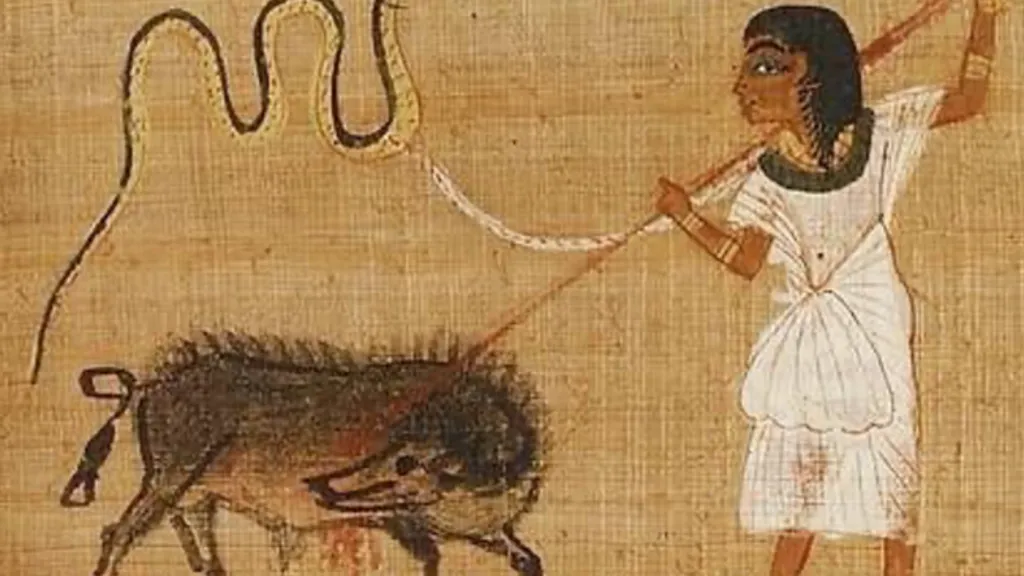
While the pig was once highly appreciated, its image degraded over the centuries in much of the Near East. The Bible, as we know, testifies to this disdain for swine since God forbids consuming its flesh (Leviticus 11:7). But the taboo against pork among the Israelites seems to be even older than the biblical prohibition, according to certain archaeological data, which show that the ban on the animal occurred almost half a millennium before the composition of the biblical texts6. Archaeologist Israel Finkelstein suggested that the ancient Israelites banned pork to distinguish themselves from their neighbors (and enemies), among whom it remained very popular7. It should be noted that the historian Tacitus (d. 117) had already made remarks to this effect (Histories, 5:4). This theory is very appealing, but it does not explain everything. Indeed, other cultures also prohibited pork before the Israelites. Michel Pastoureau explains that in Egypt, from the second millennium BCE, there was a gradual abandonment of the animal’s regular consumption, reserving it for the worship of Osiris to whom it was sacrificed: it was no longer eaten except during the full moon. Subsequently, the discredit of pork continued to intensify: its meat, reputed impure, was no longer consumed at all, and from being a sacred animal offered to Osiris, god of the Nile and vegetation, it became an attribute of Seth, the demonic god of Egyptian mythology. Seth is sometimes depicted as a black pig devouring the moon8.

Egyptian origins

The pork taboo indeed seems to originate in Pharaonic Egypt, where the animal acquires the image of an aggressive beast. In some Egyptian texts, "the pig appears as an antagonistic animal that the deceased fears the jaws of," explains Volokhine9. This image probably stems from real events during which stray pigs caused accidents. Recall that in the 12th century, Philip, son of King Louis VI the Fat and heir to the French throne, was himself overthrown and killed by a pig! The image of an aggressive beast quickly stuck and spread throughout much of the Near East, to the point that the animal was even associated with chaos deities10. In some regions, pigs were even used by armies to terrorize elephant troops, which were sometimes used as weapons of war11. However, the Sarcophagus Texts mark the first rules of pork prohibition. In one of these texts, Seth, the god of chaos and killer of Osiris, is depicted as a black pig. The god Horus, heir to the royal throne, whom Seth seeks to depose, is described as "forbidden" from pork: "thus came the prohibition of pork for Horus, by the gods and those who follow them," explains Volokhine12. Although the text is not strictly an food prohibition for humans, it "appears as the earliest reference from Near Eastern archaeological documentation mentioning a prohibition on pork"13. It is also within the Sarcophagus Texts that the very first mention of a prohibition related specifically to pork meat appears: "I know the Baou of Nekhen: it is Horus, Douamoutef, and Qebehsenouef. Do not say while eating pork" 14. Here, the taboo is limited to a very specific case: that of the priest forbidden to pronounce a ritual formula while consuming pork. But this already marks a first step toward the prohibition of pork that will soon spread throughout much of the Near East.

Expert explanations

How can we explain that pork, once highly valued, fell out of favor? We have already mentioned a possible reason, namely the animal’s aggressiveness. But this factor, which could have played a role to some extent, is certainly not the only one, and there are many theories on this subject.

Ecological explanations

A first group of theories, which can be called ecological, highlight that the pig is poorly adapted to the climate and environment of the Near East15. Marvin Harris demonstrated that the region experienced deforestation during the Bronze Age. Since pigs are particularly sensitive to heat, their breeding would have become more difficult, and their greater water needs due to the heat would have compromised cereal agriculture16. There is likely some truth to this theory, but it does not fully explain the development of the taboo itself. As archaeologist Max Price notes, "not eating pork because it is scarce or because raising pigs does not make ecological sense is very different from doing so because of a taboo"17.

Political-economic explanations

Paul Diener and Eugene Robkin proposed a more political hypothesis: that pig farming, which enriched small farmers, posed a risk to the upper classes of creating a new elite that could threaten their power and authority. The taboo would thus have been developed by urban elites to hinder the development and empowerment of villagers18. Anthropologist Frederick Simoons also argues that the taboo results from tensions between nomadic peoples — such as the primitive tribes of the Hebrews — and sedentary ones. Nomads could not raise pigs because the animal’s physique prevents it from traveling long distances. Its breeding was thus reserved for sedentary farmers. Pigs, therefore, would have been devalued by nomads, who sought to attack the sedentary population, leading to the taboo we know today19.

Biological explanations

Historian Michel Pastoureau offers an entirely different explanation. According to him, the pig is a taboo animal because it resembles humans too closely, at least on an anatomical level. Pastoureau explains that "apart from some large apes, the pig is in fact the most similar animal to humans anatomically and physiologically. Modern science confirms this daily, but ancient mythologies and medicines already knew it. The pig has been known since antiquity as a close cousin of humans" 20. The biological proximity between humans and pigs was already emphasized by Aristotle21 and in Egyptian texts22. In Europe, during the Middle Ages, human anatomy was taught by medical schools through pig dissection — since the Church forbade mutilation of the human body23. It is thus to avoid the ultimate taboo, namely cannibalism (i.e., human flesh consumption), that many cultures distanced themselves from the pig. This review of some theories concerning the pig taboo has revealed the complexity of the phenomenon. Overall, no single theory can claim to fully explain the origin of the taboo, and all probably hold some truth. What seems certain, in any case, is that the prohibition against pork dates back to a very distant era. Old traditions, as we know, are hard to break!

The pork taboo in Islam

A paradoxical situation

The Quran addresses believers, forbidding them from consuming the following: "Allah has only forbidden to you dead animals, blood, the flesh of swine, and animals over which have been invoked another name besides Allah, and those that are strangled, or killed by a blow, or those eaten by a wild beast — unless you are able to slaughter them — and those that are sacrificed on stone altars" (5:3). This list of dietary prohibitions can be compared to several ancient texts. Indeed, very similar prescriptions are found in the Talmud (Tract Sanhedrin 56a-b) but also in the Acts of the Apostles (15:29; 21:25). What stands out in this verse is that pork is the only animal whose flesh is forbidden. This situation is at least paradoxical. In his famous Natural History, the writer Pliny the Elder (d. 79) noted that "Arabia has neither wild nor domestic pigs" 24. And for good reason: the climate and water scarcity in the peninsula make it a territory unsuitable for raising these animals, which do not tolerate high heat well. Moreover, it seems that Arabs had already abstained from eating pork before Islam, as noted by historian Sozomen (d. 450): The tribe of the Saracens (= the Arabs) traces its origins from Ishmael, the son of Abraham, and therefore bears this name: the ancients called them Ishmaelites because of their ancestor. Avoiding accusations of illegitimacy and low birth of Ishmael's mother, they call themselves Saracens as if they descended from the wife of Abraham, Sarah. Possessing this kind of origin, they are circumcised like the Hebrews and observe many of their rules, including the abstention from pork25. It follows that even before the prohibition issued by the Quran, Arabs did not eat pork, partly because of the arid climate of the region, and partly because of their claimed Abrahamic lineage. So one might wonder what was the point for the Quran’s authors to ban a animal that was evidently not present at their table... Should we perhaps place the writing of the verses forbidding pork outside Arabia, in a context marked by strong Christian presence?

Reasons for the prohibition according to Muslim theologians

As for the reason behind the prohibition of pork in the Quran, it remains a different question that has made many Muslim theologians ponder. Most, however, did not seek a particular reason for the prohibition: it is a wisdom from Allah, whose reason escapes human understanding. A possible, though minority, explanation is that pigs descend from Jews whom Allah had transformed because of their disobedience (5:60). Several hadiths also state that the Prophet hesitated to eat certain animals out of fear that they might be humans transformed by Allah: "The Messenger of Allah was presented with a lizard but refused to eat it, saying: I do not know, maybe it is a descendant of past generations whose appearance has been changed" 26. In another hadith, when a Bedouin asks about the law regarding lizard meat, he answers: "O Bedouin! Truly, Allah has cursed or showed His anger towards a tribe of Banu Israel (= a Jewish tribe) and changed them into creatures that crawl on the ground. I do not know, maybe this is one of them. So, I do not eat it and do not prohibit eating it" 27. These hadiths teach us that some lizards might actually be humans Allah transformed as a punishment. But Muslim jurists are far from unanimous about the prohibition of lizard meat, which was for example made permissible by Ibn ‘Abd al-Barr (d. 1071)28. For others, the origin of the prohibition dates back to the time of the Flood. In his History of the Prophets and Kings, the eminent exegete al-Tabari (d. 923) reports the following account: that the first pig appeared on Noah’s ark: Two species of animals that were not on it came out of the ark: these were the pig and the cat. These animals did not exist on Earth before the flood, and God created them within the ark because it was filled with human waste and excrement that spread a great stench. The people in the ark, unable to bear the smell, complained to Noah: then Noah passed his hand over the back of the elephant, and the pig emerged from the anus of this animal. The pig ate all the filth present in the ark, and the stench disappeared29. Thus, the pig was created to rid humans of waste and stench, which is why Allah would have commanded humans to avoid this animal, a living trash can. The "hygienist" argument was put forward by the Jewish philosopher Maimonides (d. 1204), who claimed that the pig was "unclean," which would explain the prohibition of its flesh in the Bible30. The argument concerning the supposed dirtiness of the pig has since been widely accepted, including in contemporary discourses. The 1835 discovery of a transmissible parasite from animals to humans, trichinella spiralis, gave weight to supporters of this theory, who see it as scientific confirmation of divine prohibition. The Egyptian-born theologian Youssef al-Qaradawi (d. 2022) states: Since the pig feeds on filth and garbage, this meat is repulsive to people with good taste; moreover, recent medical research has shown that pork is harmful to health in all climates, especially in hot ones. Medical research has also shown that pork transmits a deadly parasite (trichinosis) among others [...]. Additionally, some scholars say that eating pork frequently diminishes the sense of shame of the human being regarding what is indecent31. While it is true that pork can transmit trichinosis if not cooked properly, it is far from the only meat that can do so: horses, game, dogs, and other species can also infect humans — yet they are not subject to any Quranic prohibition. Furthermore, all livestock can cause various deadly diseases in humans, as recent "mad cow" epidemics remind us. As for the legendary dirtiness of pigs, it is largely exaggerated. Certainly, they can feed on refuse if hunger forces them to. But what about animals that feed on excrement (scavengers)? Neither the Quran nor the Bible finds fault with them, and this has divided Muslim jurists. On one side, Andalusian jurist Ibn Hazm (d. 1064), who belonged to the Zhāhirī school (now extinct), declared the flesh and milk of scavenger animals forbidden. On the other, the Maliki school (majority in North Africa) considers the consumption of such animals perfectly halal, as do Hanbali jurists, who add, however, that the excrement should constitute less than half of the animal’s diet32. Why point out that pigs feed on filth if, at the same time, animals that ingest excrement are authorized for consumption? Clearly, such a position does not hold up logically, and as we will see, it also does not hold up from a Quranic perspective!

Why did Allah prohibit pork according to the Quran

Contrary to what some proponents of the "hygienist" argument would say anachronistically, the Quran does not present dietary prohibitions as measures to "protect" humans from potential health risks. On the contrary, it states: "We have only forbidden you carrion, blood, the flesh of swine, and that over which has been invoked another name besides Allah, and that which is strangled, or killed by a blow, or that which has been eaten by a wild beast — except when you are able to slaughter it — and that which is sacrificed on stone altars" (5:3). This list of prohibitions can be compared to several ancient texts. Indeed, similar prescriptions are found in the Talmud (Tract Sanhedrin 56a-b) but also in the Acts of the Apostles (15:29; 21:25). What is striking in this verse is that pork is the only animal whose meat is forbidden. This situation is quite paradoxical. In his famous Natural History, the writer Pliny the Elder (d. 79) observed that "Arabia has neither wild nor domestic pigs" 24. And for good reason: the climate and water scarcity in the peninsula make it an unsuitable territory for raising these animals, which poorly tolerate high temperatures. Moreover, it seems that Arabs had already abstained from eating pork before Islam, as noted by historian Sozomen (d. 450): The tribe of the Saracens (= the Arabs) traces its origins from Ishmael, the son of Abraham, and thus bears this name: the ancients called them Ishmaelites because of their ancestor. To avoid accusations of illegitimacy and low status of Ishmael's mother, they call themselves Saracens as if descending from the wife of Abraham, Sarah. Having this kind of origin, they are circumcised like the Hebrews and observe many of their rules, including the abstention from pork25. It appears that even before the prohibition issued by the Quran, Arabs did not consume pork, partly because of the arid climate of the region, and partly because of their claimed Abrahamic lineage. So, one might wonder what was the point for the authors of the Quran to prohibit an animal that was evidently not at their table... Should we perhaps place the drafting of the verses prohibiting pork outside of Arabia, in a context marked by strong Christian influence?

Reasons for the prohibition according to Muslim theologians

As for the reason behind the prohibition of pork in the Quran, it remains another question that has occupied many Muslim theologians. Most of them, however, did not seek a specific reason for the prohibition: it is a wisdom of Allah whose reason escapes human understanding. A possible, albeit minority, explanation is that pigs descend from Jews whom Allah transformed due to their disobedience (5:60). Several hadiths also affirm that the Prophet hesitated to eat certain animals out of fear they might be humans transformed by Allah: "The Messenger of Allah was presented with a lizard but refused to eat it, saying: I do not know, perhaps it is a descendant of past generations whose appearance has been changed" 26. In another hadith, when a Bedouin asks about the law regarding lizard meat, he replied: "O Bedouin! Truly, Allah has cursed or shown His anger towards a tribe of Banu Israel (= a Jewish tribe) and changed them into creatures that crawl on the ground. I do not know, maybe this is one of them. So, I do not eat it, and I do not forbid eating it" 27. These hadiths suggest that some lizards might actually be humans Allah transformed as a punishment. But Muslim jurists are far from unanimous about the prohibition of lizard meat, which was for example made lawful by Ibn ‘Abd al-Barr (d. 1071)28. Others suggest that the origin of the prohibition dates back to the time of the Flood. In his History of the Prophets and Kings, the renowned exegist al-Tabari (d. 923) recounts the following story: that the first pig appeared on Noah's Ark: Two species of animals that were not on it came out of the Ark: these were the pig and the cat. These animals did not exist on earth before the flood, and God created them within the ark because it was filled with human waste and excrement that spread a great stench. The people in the ark, unable to bear the smell, complained to Noah: then Noah passed his hand over the back of the elephant, and the pig emerged from the anus of that animal. The pig ate all the filth in the ark, and the stench disappeared29. The pig would therefore have been created to rid humans of waste and filth, which is why Allah would have commanded humans to keep away from this animal, a living trash can. The "hygienist" argument was put forward by the Jewish philosopher Maimonides (d. 1204), who claimed that the pig was "unclean," which would explain the prohibition of its meat in the Bible30. The argument concerning the supposed dirtiness of pork has since been largely accepted, even in contemporary discourse. The 1835 discovery of a transmissible parasite from animals to humans, trichinella spiralis, reinforced this view, which is seen as scientific confirmation of divine prohibition. The Egyptian-born theologian Youssef al-Qaradawi (d. 2022) states: Since the pig feeds on filth and garbage, this meat is repulsive to decent people; moreover, recent medical research has shown that pork is harmful to health in all climates, especially hot ones. Medical research has also shown that pork transmits a deadly parasite (trichinosis) among others [...]. Additionally, some scholars say that eating pork frequently diminishes the sense of shame in humans regarding what is indecent31. While it is true that pork can transmit trichinosis if not cooked properly, it is far from the only meat capable of doing so: horses, game, dogs, and other species can also infect humans — yet they are not subject to any Quranic prohibition. Furthermore, all livestock can cause various deadly diseases in humans, as recent "mad cow" epidemics remind us. As for the legendary dirtiness of pigs, it is largely exaggerated. Certainly, they can feed on refuse if hunger forces them. But what about animals that feed on excrement (scavengers)? Neither the Quran nor the Bible finds fault with them, and this has divided Muslim jurists. On one side, Andalusian jurist Ibn Hazm (d. 1064), who belonged to the Zhāhirī school (now extinct), declared the flesh and milk of scavenger animals forbidden. On the other, the Maliki school (majority in North Africa) considers the consumption of such animals perfectly halal, as do Hanbali jurists, who add, however, that the excrement should constitute less than half of the animal’s diet32. Why highlight that pigs feed on filth if, at the same time, animals that ingest excrement are legally permissible? Clearly, such a position does not hold logically, and as we will see, it also does not hold from a Quranic point of view!

Why did Allah prohibit pork according to the Quran

Contrary to what proponents of the "hygienist" argument somewhat anachronistically claim, the Quran does not present dietary prohibitions as measures to "protect" humans from potential health risks. It states instead: "We have only forbidden to you carrion, blood, the flesh of swine, and that over which has been invoked another name besides Allah, and that which is strangled, or killed by a blow, or that which has been eaten by a wild beast — except when you are able to slaughter it — and that which is sacrificed on stone altars" (5:3). This list of prohibitions can be compared to several ancient texts. Indeed, similar prescriptions are found in the Talmud (Tract Sanhedrin 56a-b) but also in the Acts of the Apostles (15:29; 21:25). What is striking in this verse is that pork is the only animal whose meat is prohibited. This situation is quite paradoxical. In his famous Natural History, the writer Pliny the Elder (d. 79) noted that "Arabia has neither wild nor domestic pigs" 24. And for good reason: the climate and water scarcity in the peninsula make it an unsuitable territory for raising these animals, which tolerate high heat poorly. Moreover, it seems that Arabs had already abstained from eating pork before Islam, as noted by historian Sozomen (d. 450): The tribe of the Saracens (= the Arabs) traces its origins from Ishmael, the son of Abraham, and bears this name: the ancients called them Ishmaelites because of their ancestor. To avoid accusations of illegitimacy and low status of Ishmael's mother, they call themselves Saracens as if descending from the wife of Abraham, Sarah. Having this origin, they are circumcised like the Hebrews and observe many of their rules, including abstaining from pork25. It appears that even before the prohibition imposed by the Quran, Arabs did not eat pork, partly due to the arid climate of the region and partly because of their claimed Abrahamic heritage. So, what was the purpose for the authors of the Quran to ban an animal that was evidently not at their table... Should we perhaps date the drafting of the verses prohibiting pork outside of Arabia, in a context marked by strong Christian influence?

Reasons for the prohibition according to Muslim theologians

As for the reason for the prohibition of pork in the Quran, it remains another question that has occupied many Muslim scholars. Most of them, however, did not seek a specific motive: it is a wisdom of Allah for which the reason is beyond human comprehension. A possible, though minor, explanation is that pigs descend from Jews whom Allah transformed due to their disobedience (5:60). Several hadiths also state that the Prophet hesitated to eat certain animals out of fear they might be humans transformed by Allah: "The Messenger of Allah was shown a lizard but refused to eat it, saying: I do not know, perhaps it is a descendant of past generations whose appearance has been changed" 26. In another hadith, when a Bedouin asks about the law regarding lizard meat, he responded: "O Bedouin! Indeed, Allah has cursed or shown His wrath to a tribe of Banu Israel (= a Jewish tribe) and transformed them into crawling creatures of the earth. I do not know, perhaps this is one of them. So, I do not eat it, and I do not forbid eating it" 27. These hadiths suggest that some lizards might actually be humans whom Allah transformed as punishment. However, Muslim jurists are far from unanimous regarding the prohibition of lizard meat, which was for instance made lawful by Ibn ‘Abd al-Barr (d. 1071)28. Others suggest that the origin of the prohibition goes back to the time of the Flood. In his History of the Prophets and Kings, the renowned exegete al-Tabari (d. 923) recounts the following story: that the first pig appeared on Noah’s Ark: Two kinds of animals that were not on board emerged from the Ark: these were the pig and the cat. These animals did not exist on the earth before the flood, and God created them within the ark because it was filled with human waste and excrement that emitted a strong stench. The people in the ark, unable to endure the smell, complained to Noah: then Noah placed his hand over the back of the elephant, and the pig came out from the anus of this animal. The pig ate all the filth in the ark, and the stench disappeared29. The pig would therefore have been created to rid humans of waste and filth, which is why Allah would have ordered humans to avoid this animal, a living trash bin. The "hygienist" argument was advanced by the Jewish philosopher Maimonides (d. 1204), who claimed that the pig was "unclean," which would explain the prohibition of its flesh in the Bible30. The argument about the supposed filthiness of pigs has since been largely accepted, including in contemporary discourse. The 1835 discovery of a transmissible parasite from animals to humans, trichinella spiralis, reinforced this view, which is seen as scientific confirmation of divine prohibition. The Egyptian-born theologian Youssef al-Qaradawi (d. 2022) states: Since the pig feeds on filth and rubbish, this meat is disgusting to decent people; furthermore, recent medical research has shown that pork is harmful to health in all climates, especially in hot ones. Medical research has also shown that pork transmits a deadly parasite (trichinosis) among others [...]. Additionally, some scholars say that eating pork often diminishes the sense of shame that human beings should have regarding indecency31. While it is true that pork can transmit trichinosis if not properly cooked, it is far from being the only meat capable of doing so: horses, game, dogs, and other animals can also infect humans — yet they are not subject to any Quranic prohibition. Moreover, all livestock can cause various deadly diseases in humans, as evidenced by recent "mad cow" epidemics. Regarding the legendary dirtiness of pigs, it has been largely exaggerated. Certainly, they can feed on trash if hunger compels them. But what about animals that feed on excrement (scavengers)? Neither the Quran nor the Bible condemns them, and this has caused disagreements among Muslim jurists. On one side, Andalusian jurist Ibn Hazm (d. 1064), belonging to the Zhāhirī school (now extinct), declared the flesh and milk of scavenging animals forbidden. On the other side, the Maliki school (majority in North Africa) considers the consumption of such animals perfectly halal, as do Hanbali jurists who add, however, that the excrement should constitute less than half of the animal’s diet32. Why point out that pigs feed on filth if, at the same time, animals that ingest excrement are permitted for consumption? Obviously, such a stance does not hold logically, and as we will see, it also does not match the Quranic perspective!

Why did Allah prohibit pork according to the Quran

Contrary to what advocates of the "hygienist" argument claim somewhat anachronistically, the Quran does not present dietary prohibitions as measures to "protect" humans from potential health risks. Instead, it explicitly states: "We have only forbidden to you carrion, blood, the flesh of swine, and that over which has been invoked another name besides Allah, and that which is strangled, or killed by a blow, or that which has been eaten by a wild beast — except when you are able to slaughter it — and that which is sacrificed on stone altars" (5:3). This list of prohibitions can be compared to several ancient texts. Indeed, similar regulations are found in the Talmud (Tract Sanhedrin 56a-b) as well as in the Acts of the Apostles (15:29; 21:25). What stands out in this verse is that pork is the only animal whose meat is forbidden. This situation is quite paradoxical. In his famous Natural History, Pliny the Elder (d. 79) notes that "Arabia has neither wild nor domestic pigs" 24. And for good reason: the climate and water scarcity in the region make it unsuitable for raising these animals, which do not tolerate high temperatures well. Moreover, it appears that Arabs had already been abstaining from eating pork before Islam, as noted by historian Sozomen (d. 450): The tribe of the Saracens (= Arabs) traces its origins from Ishmael, the son of Abraham, and has this name: the ancients called them Ishmaelites because of their ancestor. To avoid accusations of illegitimacy and low status of Ishmael's mother, they call themselves Saracens as if descending from the wife of Abraham, Sarah. Possessing such an origin, they are circumcised like the Hebrews and observe many of their laws, including abstaining from pork25. It seems that even before the prohibition established by the Quran, Arabs did not consume pork, partly because of the dry climate of the region, and partly because of their claimed Abrahamic lineage. So, what was the point for the framers of the Quran to ban an animal that was not present at their table... Should we perhaps date the drafting of the verses prohibiting pork outside of Arabia, in a context influenced heavily by Christianity?

Reasons for the prohibition according to Muslim theologians

As for the reason behind the prohibition of pork in the Quran, it remains a different matter that has engaged many Muslim scholars. The majority, however, did not seek a specific reason: it is a wisdom from Allah whose purpose is beyond human understanding. One minor, though some argue plausible, explanation is that pigs descend from Jews whom Allah transformed because of their disobedience (5:60). Several hadiths also mention that the Prophet hesitated to eat certain animals out of fear that they might be humans transformed by Allah: "The Messenger of Allah was presented with a lizard but refused to eat it, saying: I do not know, perhaps it is a descendant of past generations whose appearance has been changed" 26. In another hadith, when a Bedouin asks about the law concerning lizard meat, he replied: "O Bedouin! Indeed, Allah has cursed or shown His anger towards a tribe of Banu Israel (= a Jewish tribe) and transformed them into crawling creatures on the ground. I do not know, perhaps this is one of them. So, I do not eat it nor do I prohibit eating it" 27. These hadiths suggest that some lizards might actually be humans whom Allah transformed as punishment. However, Muslim jurists are far from unanimous on the prohibition of lizard meat, which was for example made lawful by Ibn ‘Abd al-Barr (d. 1071)28. Others believe that the origin of the prohibition dates back to the time of the Flood. In his History of the Prophets and Kings, the famous exegist al-Tabari (d. 923) recounts the story that the first pig appeared on Noah’s Ark: Two kinds of animals that were not on the ark came out of it: these were the pig and the cat. These animals did not exist on earth before the flood, and God created them within the ark because it was filled with human waste and excrement that emitted a strong foul smell. The people in the ark, unable to bear the smell, complained to Noah: then Noah placed his hand on the back of the elephant, and the pig emerged from the anus of that animal. The pig ate all the filth inside the ark, and the foul smell disappeared29. The pig was therefore created to rid humans of waste and filth, which is why Allah would have ordered humans to avoid this animal, a living garbage dump. The "hygienist" argument was advanced by the Jewish philosopher Maimonides (d. 1204), who claimed that the pig was "unclean," which would explain the prohibition of its meat in the Bible30. The idea that pigs are unclean has since been largely accepted, including in contemporary discussions. The 1835 discovery of a transmissible parasite from animals to humans, trichinella spiralis, reinforced this view, which is seen as scientific confirmation of divine prohibition. The Egyptian-born theologian Youssef al-Qaradawi (d. 2022) states: Since the pig feeds on filth and refuse, this meat is repulsive to decent people; moreover, recent medical research has shown that pork is harmful to health in all climates, especially in hot regions. Medical research has also shown that pork transmits a deadly parasite (trichinosis), among others [...]. Additionally, some scholars say that frequently eating pork diminishes the sense of shame that humans should have regarding indecency31. While it is true that pork can transmit trichinosis if not properly cooked, it is far from the only meat capable of transmitting it: horses, game, dogs, and other animals can also infect humans — yet they are not subject to any Quranic prohibition. Moreover, all livestock are capable of transmitting various deadly diseases to humans, as recent outbreaks of "mad cow disease" remind us. Regarding the legendary filthiness of pigs, it has largely been exaggerated. Indeed, they can feed on refuse if hunger compels them. But what about animals that eat excrement (scavengers)? Neither the Quran nor the Bible condemns them, and this has divided Muslim jurists. On one side, Andalusian jurist Ibn Hazm (d. 1064), who belonged to the Zhāhirī school (now extinct), declared the flesh and milk of scavenger animals forbidden. On the other side, the Maliki school (majority in North Africa) considers the consumption of such animals perfectly halal, as do Hanbali jurists, who add that the excrement should constitute less than half of the animal’s diet32. Why emphasize that pigs feed on filth if, at the same time, animals that feed on excrement are allowed? Clearly, a position like this does not hold up logically, and as we will see, it also does not align with the Quranic perspective!

Why did Allah prohibit pork according to the Quran

Contrary to what proponents of the "hygienist" argument claim prematurely, the Quran does not present dietary prohibitions as measures to "protect" humans from potential health dangers. It explicitly states: "We have only forbidden to you dead animals, blood, the flesh of swine, and that over which has been invoked another name besides Allah, and that which is strangled, or killed by a blow, or that which has been devoured by a wild beast — except when you are able to slaughter it — and that which is sacrificed on stone altars" (5:3). This list of prohibitions can be compared to several ancient texts. Similar prescriptions are found in the Talmud (Tract Sanhedrin 56a-b) and in the Acts of the Apostles (15:29; 21:25). What is remarkable in this verse is that pork is the only animal whose meat is forbidden. This situation is quite paradoxical. In his famous Natural History, Pliny the Elder (d. 79) observed that "Arabia has neither wild nor domestic pigs" 24. And for good reason: the climate and water shortage in the peninsula make it an unsuitable land for raising these animals, which do not tolerate high heat well. Additionally, it seems that Arabs had already abstained from eating pork before Islam, as noted by historian Sozomen (d. 450): The tribe of the Saracens (= Arabs) traces its origins from Ishmael, the son of Abraham, and is called by that name: the ancients called them Ishmaelites because of their ancestor. To avoid accusations of illegitimacy and low status of Ishmael's mother, they call themselves Saracens as if they descended from the wife of Abraham, Sarah. Having this origin, they are circumcised like the Hebrews and observe many of their laws, including abstinence from pork25. It appears that even prior to the prohibition established by the Quran, Arabs did not eat pork, partly because of the arid climate of the region and partly because of their claimed Abrahamic lineage. So, what was the purpose for the authors of the Quran in banning an animal that was not present at their table... Should we perhaps date the writing of the verses prohibiting pork outside Arabia, in a context influenced heavily by Christianity?

Reasons for the prohibition according to Muslim theologians

As for the reason for the prohibition of pork in the Quran, it remains an entirely separate question that has occupied many Muslim scholars. The majority, however, did not seek a specific reason: it is a divine wisdom whose purpose is beyond human comprehension. A minor, yet some argue plausible, explanation is that pigs descend from Jews whom Allah transformed due to their disobedience (5:60). Several hadiths also mention that the Prophet hesitated to eat certain animals out of fear they might be humans transformed by Allah: "The Messenger of Allah was shown a lizard but refused to eat it, saying: I do not know, perhaps it is a descendant of past generations whose appearance has been changed" 26. In another hadith, when a Bedouin asks about the law regarding lizard meat, he answered: "O Bedouin! Indeed, Allah has cursed or shown His anger towards a tribe of Banu Israel (= a Jewish tribe) and transformed them into crawling creatures on the ground. I do not know, perhaps this is one of them. So, I do not eat it, nor do I prohibit eating it" 27. These hadiths suggest that some lizards might actually be humans whom Allah transformed as punishment. But Muslim jurists are far from unanimous regarding the prohibition of lizard meat, which was for instance made lawful by Ibn ‘Abd al-Barr (d. 1071)28. Others argue that the origin of the prohibition goes back to the time of the Flood. In his History of the Prophets and Kings, the renowned exegete al-Tabari (d. 923) recounts the following story: that the first pig appeared on Noah's Ark: Two kinds of animals that were not on the ark came out of it: these were the pig and the cat. These animals did not exist on earth before the flood, and God created them within the ark because it was filled with human waste and excrement that emitted a strong foul smell. The people on the ark, unable to bear the smell, complained to Noah: then Noah put his hand over the back of the elephant, and the pig emerged from the anus of this animal. The pig ate all the filth in the ark, and the foul smell disappeared29. The pig was thus created to rid humans of waste and filth, and that is why Allah would have commanded humans to keep away from this animal, a living garbage dump. The "hygienist" argument was advanced by the Jewish philosopher Maimonides (d. 1204), who claimed that the pig was "unclean," which would explain the prohibition of its flesh in the Bible30. The belief that pigs are unclean has since been largely accepted, including in modern discussions. The 1835 discovery of a transmissible parasite from animals to humans, trichinella spiralis, confirmed this view, which is seen as scientific proof of divine prohibition. The Egyptian-born theologian Youssef al-Qaradawi (d. 2022) states: Since the pig feeds on filth and garbage, this meat is revolting to decent people; furthermore, recent medical research has demonstrated that pork is harmful to health in all climates, especially hot ones. Research has also shown that pork transmits a deadly parasite (trichinosis) among others [...]. Additionally, some scholars say that eating pork frequently diminishes the sense of shame that humans should have regarding indecency31. While it is true that pork can transmit trichinosis if not cooked properly, it is far from the only meat capable of transmitting it: horses, game, dogs, and other animals can also infect humans — yet they are not subject to any Quranic prohibition. Moreover, all livestock can cause various deadly diseases in humans, as recent "mad cow" outbreaks have demonstrated. Regarding the legendary dirtiness of pigs, it has been largely exaggerated. Certainly, they can feed on refuse if hunger forces them. But what about animals that eat excrement (scavengers)? Neither the Quran nor the Bible condemns them, and this has caused disagreements among Muslim jurists. On one side, Andalusian jurist Ibn Hazm (d. 1064), who belonged to the Zhāhirī school (now extinct), declared the flesh and milk of scavenger animals forbidden. On the other side, the Maliki school (majority in North Africa) considers the consumption of such animals perfectly halal, as do Hanbali jurists, who add that the excrement should make up less than half of the animal’s diet32. Why point out that pigs feed on filth if, at the same time, animals that eat excrement are allowed? Evidently, this position is illogical, and as we will see, it does not correspond to the Quranic perspective either!

Why did Allah prohibit pork according to the Quran

Contrary to what supporters of the "hygienist" argument suggest prematurely, the Quran does not present dietary prohibitions as measures to "protect" humans from health risks. Instead, it declares: "We have only forbidden to you carrion, blood, the flesh of swine, and that over which has been invoked another name besides Allah, and that which is strangled, or killed by a blow, or that which has been eaten by a wild beast — unless you are able to slaughter it — and that which is sacrificed on stone altars" (5:3). This list of prohibitions can be compared to several ancient prescriptions. Similar regulations are found in the Talmud (Tract Sanhedrin 56a-b) and in the Acts of the Apostles (15:29; 21:25). What stands out is that pork is the only animal whose flesh is forbidden. This situation remains quite paradoxical. In his famous Natural History, Pliny the Elder (d. 79) noted that "Arabia has neither wild nor domestic pigs" 24. And for good reason: the climate and water scarcity in the region make it an inadequate place for raising these animals, which do not tolerate high temperatures well. Additionally, it appears that Arabs had already refrained from eating pork before Islam, partly because of the dry climate of the region and partly because of their claimed Abrahamic heritage. So, what was the purpose of the Quranic bans for an animal that was not at their table...? Perhaps the verses were formulated outside Arabia, in a context strongly influenced by Christianity?

Reasons for the prohibition according to Muslim theologians

Regarding the reasons for pork prohibition in the Quran, it remains a question that has intrigued many Muslim scholars. Most of them did not seek a specific reason: it is a divine wisdom, whose purpose is beyond human comprehension. One minor but plausible explanation is that pigs descend from Jews whom Allah transformed because of their disobedience (5:60). Several hadiths also indicate that the Prophet hesitated to eat certain animals out of fear they might be humans transformed by Allah: "The Messenger of Allah was shown a lizard but refused to eat it, saying: I do not know, perhaps it is a descendant of past generations whose appearance has been changed" 26. In another hadith, when a Bedouin asked about the law regarding lizard meat, he replied: "O Bedouin! Indeed, Allah has cursed or expressed His anger toward a tribe of Banu Israel (= a Jewish tribe), and transformed them into crawling creatures on the earth. I do not know, perhaps this is one of them. So, I do not eat it, nor do I prohibit eating it" 27. These hadiths suggest that some lizards might actually be humans whom Allah transformed as punishment. However, Muslim jurists are far from unanimous regarding the prohibition of lizard meat, which was for example made lawful by Ibn ‘Abd al-Barr (d. 1071)28. Others believe that the prohibition’s origin dates back to the time of the Flood. In his History of the Prophets and Kings, the renowned exegete al-Tabari (d. 923) recounts the following story: that the first pig appeared on Noah’s Ark: Two kinds of animals that were not on the ark emerged from it: the pig and the cat. These animals did not exist on earth before the flood, and God created them within the ark because it was filled with human waste and excrement that emitted a strong stench. The people in the ark, unable to bear the smell, complained to Noah: then Noah placed his hand on the back of the elephant, and the pig came out of the anus of that animal. The pig ate all the filth in the ark, and the foul smell disappeared29. The pig was created to rid humans of waste and filth, which explains why Allah would have commanded humans to avoid this animal, a living trash can. The "hygienist" argument was advanced by the Jewish philosopher Maimonides (d. 1204), who claimed that the pig was "unclean," which would justify the prohibition of its flesh in the Bible30. The idea that pigs are unclean has since been largely accepted, including in modern discussions. The 1835 discovery of a transmissible parasite from animals to humans, trichinella spiralis, reinforced this view, seen as scientific proof of divine prohibition. The Egyptian-born theologian Youssef al-Qaradawi (d. 2022) states: Since the pig feeds on filth and garbage, this meat is revolting to decent people; moreover, recent medical research has shown that pork is harmful to health in all climates, especially in hot ones. Medical research has also shown that pork transmits a deadly parasite (trichinosis) among others [...]. Additionally, some scholars argue that frequent consumption of pork diminishes the sense of shame in humans regarding indecency31. While it is true that pork can transmit trichinosis if not cooked properly, it is far from the only meat capable of doing so: horses, game, dogs, and other animals can also infect humans — yet they are not subject to any Quranic prohibition. Furthermore, all livestock can cause various deadly diseases in humans, as evidenced by recent "mad cow" outbreaks. Regarding the legendary filthiness of pigs, it has largely been exaggerated. Certainly, they can feed on refuse if hunger compels them. But what about animals that feed on excrement (scavengers)? Neither the Quran nor the Bible condemns them, and this has caused disagreements among Muslim jurists. On one side, Andalusian jurist Ibn Hazm (d. 1064), member of the Zhāhirī school (now extinct), declared the flesh and milk of scavenger animals forbidden. On the other, the Maliki school (majority in North Africa) considers the consumption of such animals perfectly halal, as do Hanbali jurists, who add that the excrement should constitute less than half of the animal’s diet32. Why emphasize that pigs feed on filth if, at the same time, animals that eat excrement are allowed? Such a stance clearly does not make sense, and as we will see, it does not align with the Quranic perspective either!