Introduction
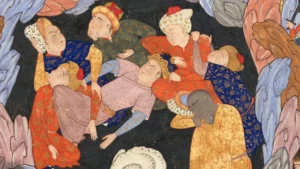
Surah 18 recounts the story of the miraculous sleep of the companions of the cave (18:9-26). The story can be summarized as follows: several young companions, of uncertain number, are persecuted because of their faith in Allah. They retreat into a cave where they sleep for 309 years, while their dog stays outside the cave at the entrance, guarding it. During their sleep, Allah turns the bodies of the companions from right to left, seemingly to protect them from the sun's rays. Upon awakening, the companions think they have only slept one day or part of a day. They send one of theirs to the city to bring provisions but are eventually discovered. Their story bears witness to the resurrection of the bodies.
It is well known that the story of the companions of the cave is inspired by the legend of the Dormant Ones of Ephesus, whose full text can be found by clicking on this link. The story takes place in Ephesus, present-day Turkey, during the reign of Emperor Decius (249–251), marked by persecutions against Christians. Several young companions, generally seven in number, persecuted because of their Christian faith, hide inside a cave. The emperor, informed of their hiding place, decides to brick up the cave's entrance to imprison them. The young people then fall into a long sleep and awaken under the reign of Theodosius (408–450), by which time the empire had converted to Christianity, believing they had only slept for one night. They send one of their number to bring food; he is surprised to find his city has become Christian. He notices this as he tries to pay with old coins bearing Decius's image. The companions recount their story and are recognized by an old sage, and the miracle of their resurrection soon spreads across the country.
The dependence of the Quranic story on the legend of the Dormants of Ephesus is widely accepted among scholars1. Sidney Griffith, author of a seminal study on this theme, notes "a remarkable coincidence of words, expressions, or narrative details" between the Quranic text and the legend2. It should also be emphasized that Muslim exegetes were aware that a story very similar to the Quranic one circulated among Christians. Conversely, Christians did not hesitate to draw from the Christian legend to enrich their commentaries3. The purpose of this article is to highlight the significant similarities between the Quran and the story of the Dormants of Ephesus.
Origins and Transmission of the Legend
It is now well established that the story of the Dormants of Ephesus emerged in the 5th century, initially as an oral tale. It soon appeared in numerous translations, ensuring widespread dissemination both in the Near East and Europe. The earliest known version is the Syriac version by Bishop Jacob of Sarug (d. 521). It was followed by the Frankish historian Gregory of Tours (d. 594), who produced the first Latin version. The pilgrim Theodosius, who visited the tomb of the sleepers in Ephesus around 530, briefly mentions the legend in his pilgrimage guide De situe Terrae Sanctae4. We should also mention the chronicler Dennis of Tell-Mahré (d. 845), who relied on a Syriac text from the 5th century5. This text did not survive, but over 200 manuscripts in Latin, Greek, Syriac, Arabic, Ethiopian, Coptic, and Armenian are known. The oldest, written in Syriac, is held at the Saint Petersburg Museum and dates from the 5th-6th century6. While the antiquity of the legend is undisputed, the question of its original cultural milieu has sparked much debate. According to most scholars, it would have been written in Greek around 450 by Stephen of Ephesus, before being transmitted to the Eastern world via the version given by Jacob of Sarug7.
The story of the sleepers was well known in antiquity thanks to the numerous translations it underwent. It already circulated among pre-Islamic Arabic-speaking Christians, both in Syria-Jordan and in Najran, Yemen. It was also known to Syriac monks, who mentioned it in their sermons8. Multiple pathways of transmission thus exist to explain how this legend spread among the communities that produced the Quranic text. In a stimulating study, Thomas Eich demonstrated that the Quranic version of the legend originates from a Palestinian source9. However, this source was not necessarily a written text. Several clues point towards an oral source, closer to popular narratives10. Michel Tardieu emphasizes that the Quranic story "represents the layer of the legend closest to the pagan cultural environment in which it was formed as an oral tradition tale" 11.
Another relevant question is why the author of the legend, whoever they may be, chose to invent this story. Indeed, creating a narrative is rarely a gratuitous act; it generally aims to satisfy a specific need or goal (political, theological, etc.). In the case of the Dormants of Ephesus, the purpose was to counter certain currents within Christianity that denied the resurrection of bodies12. Several currents had rallied around the position of Origen (d. 253), a prominent early Christian theologian, who was nonetheless condemned because of some ideas. He was reproached, notably, for claiming that only the soul was involved in the resurrection, not the body, which could not remain intact13. This idea sparked intense theological debates and led to what is called the "Origenist controversy" 14. However, Origen's ideas about the resurrection resurfaced at the end of antiquity15. A Syriac chronicle from the 5th century reports for example the presence of a "heretical" group that denied the resurrection of bodies16. The risk of growing heterodox currents led the author of the Dormants of Ephesus to craft an edifying story to prove the preservation of the sleepers' bodies during their secular sleep and their resurrection.
It is interesting to note that in the 6th century, the Syriac theologian Babaï the Great was not hesitant to cite the example of the Dormants of Ephesus to refute opponents whom he accused of denying the resurrection. Again, the story of the companions of the cave in the Quran is presented here as a proof of the resurrection of bodies17. This demonstrates the controversies over the resurrection in the 6th and 7th centuries within an Arab-speaking Christian context or more broadly Syriac. 18. The Nestorian chronicle, for example, mentions the existence at the end of the 6th century of a "heresy of the Arabs," whose members were accused of denying the resurrection19. Is it possible that the Quranic story was specifically addressed to them? The question remains entirely open. In any case, it is interesting to note that the authors of the Quran used the same rhetorical arsenal to prove the resurrection of the bodies as their Syriac predecessors20.
A final point worth addressing: the mythic origins of the story of the Dormants of Ephesus — and by extension its Quranic version. Historians have long emphasized that the story "stems from an old mythological background"21. It borrows, as we will revisit, many themes found in the folklore around the Mediterranean. Far from simply drawing parallels between the Quranic story and the legend of the Dormants of Ephesus, this article aims to explore the mythological sources from which they originate.
The Quran and the Legend of the Dormants of Ephesus
The Companions of the Cave
Let's start our analysis with the main protagonists of the story. They are called in the Quran and the legend as young companions. The Christian version specifies that they were from good families, usually named: Maximus, Malcus, Martinianus, Dyonisius, John, Serapion, and Constantine. In contrast, in the Quran, the companions are anonymous and almost no details about them are provided22. Another similarity between the Quran and the legend is that the companions are persecuted because of their belief in the one true God. However, the Quran does not explicitly identify them as Christians; it simply describes them as "young companions who believed in their Lord." Islamic tradition often portrays them as "Muslims" who followed the religion of Jesus—that is, Islam. The commentator Ibn Kathir (d. 1373) also suggests that the story might have taken place before Christianity, though he places the scene during the reign of Emperor Datius, in the mid-3rd century23.
Regarding the number of companions mentioned in the legend: they are usually seven—an auspicious number—but sometimes four or even eight are mentioned. The Quranic author seems aware of the different accounts:
They will say, "They were three, and their dog was fourth." And they will say, "Five, and their dog was sixth"—guessing at their mystery. Say, "My Lord knows best their number. Only a few people know their true count" —.
Contrary to what might be expected, the Quran does not make a definitive ruling on this matter. However, Geneviève Gobillot noted an interesting detail: by adding the numbers mentioned in the Quran in this passage (3 + 4 + 5 + 6 + 7 + 8), the sum is 33, which, according to Christian tradition, is the age Jesus was at the time of his death and resurrection24. It is, of course, possible that this is merely a numerical coincidence, but given the strong affinity of the story with the theme of resurrection, it cannot be ruled out that it was a deliberate act by the Quranic author(s).
Al-raqim: Revisiting an Enigmatic Term
The Quran begins the story by talking about the "companions of the cave and al-raqim". The meaning of the term al-raqim, which we intentionally left in Arabic, has eluded Muslim exegetes and remains mysterious today. The mufassirun have proposed many interpretations without reaching a consensus. Some suggest it refers to the name of the dog accompanying the youth; others say it’s the name of the cave itself, or of the region where it is located. Still others believe it means "inscription" or "tablet". Al-Tabari (d. 923) comments on this:The most plausible among these is that it designates a tablet, or a stone, or some support for an inscribed text. Chroniclers have indicated that it is a tablet on which the names and story of the people of the cave were inscribed when they sought refuge there; this tablet, it has been said, was kept in the king's library or, according to another version, placed at the threshold of the cave25.
We will revisit this last interpretation soon. For now, note that exegetes are perplexed by this term which they clearly do not understand and desperately seek to clarify its meaning. This again illustrates the well-recognized rupture between the environment that produced the Quran and the environment that received the text26.
In Quranic scholarship, there is also no consensus regarding the meaning of the term. One hypothesis is that it refers to a toponym designating the city of Petra, the ancient capital of the Nabataean kingdom (present-day Jordan). By examining inscriptions and pre-Islamic geographical texts, Mehdy Shaddel argued that the Semitic name for Petra was RQM, which corresponds to the triliteral root of al-raqim. According to Shaddel, the Quran would present an Arabic version of the story of the Dormants of Ephesus, locating the cave’s site at Petra28. Although attractive a priori, this hypothesis raises some difficulties. In particular, the city of Petra was abandoned by its inhabitants due to the decline of caravanning trade, which was once its wealth, and after the earthquake that destroyed the city in 363. References to the ancient caravan city diminish and disappear entirely from the 6th century onward29. Under these conditions, it becomes difficult to explain the supposed mention of its name in the Quran.
James Bellamy offered a very different interpretation: starting from the fact that the Quranic text reached us in an altered form, he suggests that one should not read al-raqim but rather al-ruqûd, meaning "sleepers" or "dormants"30. Corrected this way, the passage would be the Arabic translation of the name under which the story of the Dormants of Ephesus circulated in antiquity. According to another hypothesis, drawing on Arab lexicographers who relate the root r-q-m to the concept of writing, the term would mean "inscription" or "tablet" 31. Remember that this was already one of the interpretations proposed by the mufassirun. All versions of the legend mention a tablet inscribed with the names of the companions32. Therefore, that is likely the sense of al-raqim.
The Cave: Symbolic and Mythical Place
Another common point between the Quranic story and the legend of the Dormants of Ephesus naturally concerns the location where the scene takes place: the cave. Most versions locate it in Ephesus, an emblematic city of ancient paganism, which would later become one of the cradles of Christianity. Today, the city no longer exists; the Turkish population inhabits the neighboring city of Selçuk and leverages the tourist allure of the famous cave, which attracts many visitors from both Christian and Muslim backgrounds. It was originally a cave dedicated to Pan, the bearded god with goat legs. The Ephesians would go there to immure a young girl with dubious virginity alive. If the melodious sound of Pan's flute echoed from the cave, it meant she was a virgin and thus saved. Otherwise, her screams betrayed her fault, and the horned god took care of her33.
The cave is not a randomly chosen setting by the author of the legend. In many traditions, in ancient Greece but also in the Near East, it symbolizes the place of rebirth and regeneration of the hero34. It is also, by definition, the site of mystical and initiatory experiences and of encounters between humans and the divine35. Poets and prophets, endowed with divine gift, go there to find inspiration. It is not surprising that many myths and miraculous stories unfold inside a cave. After sleeping for 57 years in a cave, young Epimenides became an accomplished poet36. Muhammad received his first revelation while doing spiritual retreat in the cave of Hira. Many ancient stories feature miraculous encounters between a monk and an angel inside a cave—so much so that the episode of Muhammad’s prophetic investiture is undoubtedly inspired by such a story37. The cave also serves as a refuge for persecuted heroes. In the Bible, David flees to the Cave of Adullam to escape King Saul’s soldiers (1 Samuel 22:1). Some chronicles mention that in the 7th century, monks would hide in caves to escape Bedouin attacks38. There is also the well-known story of Muhammad seeking refuge in a cave to escape the Quraysh. According to legend, a spider spun a web at the cave’s entrance to deceive those who wanted to harm the Prophet39.
Let us now return to the story of interest here: the legend of the Dormants of Ephesus and its implications for the Quran. Several mythological sources have been brought to light by historians. For example, a legendary story claims that the apostle John was not killed as tradition states, but rather "that he was pursued by the inhabitants of a certain city, climbed a mountain, and hid from their sight, and no one knew what became of him" (Patrologia Orientalis vol. VII). As David Sidersky notes, "the mountain mentioned here resembles a cave. Moreover, the legend of John is set in Ephesus, like that of the sleepers in the cave" 40. This account offers an interesting parallel with the story of the Dormants of Ephesus because it involves themes of a hero persecuted for his faith, the cave (or mountain) as a place of refuge, and an event unfolding in the city of Ephesus.
Michel Tardieu further demonstrated that the story of the Dormants of Ephesus is heavily inspired by a pagan myth, the cave of Aïon41. In Greek mythology, Aïon is the god of infinite time who resides in the cave of eternity. In the 4th century, Claudian, a poet at the court of Honorius, described the cave of Time in a poem from which we present an excerpt:
"In a distant and unknown region, inaccessible to our race, almost forbidden even to the gods themselves, lies the dark place from which arise the years, the cave of Eternity, from which centuries fly out, and where they return. […] Nature, sitting at the door, guards the entrance […]"
In the Quran, but also, as we will see, in some Christian versions of the legend, the nature that guards the entrance of the cave takes the form of a dog.
The Miraculous Sleep
The story of the Dormants of Ephesus and the Quranic account also converge on the miraculous sleep in which the protagonists fall. After seeking refuge in the cave, the companions fall into a sleep that lasts several centuries. Mythologists relate this story to myths of "sleeping heroes" (sleeping heroes) abundant in antiquity43. As Elissa Henken explains, "these sleeping heroes are often redemptive heroes, whether for a nation or a religious group […]. The legend often arises when a group with a distinct consciousness of identity feels deeply oppressed by foreigners" 44. Many examples of "sleeping heroes" exist in the Indo-European area. For instance, King Arthur, whose legend tells of a long sleep on the island of Aval. It’s worth recalling that the name Arthur, in its Latin, Welsh, or Breton derivatives, always refers back to the Greek arctos, meaning "bear", associated with the myth of cyclic hibernation in a cave imposed by nature45. There clearly exists a very ancient mythological motif in Indo-European culture linking themes of miraculous sleep and the hero's rescue. This mythic background gave rise to the legend of the Dormants of Ephesus and, consequently, to the story of the cave companions in the Quran. The legend has many antecedents, some of which have been thoroughly studied by Pieter van der Horst in a seminal work46. Without claiming exhaustiveness, we will present several of these prehistoric mythic tales that predate the legend of the sleepers and the Quran.
A first example is given in Aristotle’s Physics, which explains: "Now, time does not exist without change; indeed, when we do not undergo changes in our thought, or fail to perceive them, it does not seem that any time has passed; it is the same impression as when people who, according to the myth, slept in Sardis near the hero, connect the moment before with the moment after and treat them as one, removing the interval because it is devoid of sensation" 47. In this passage, Aristotle refers to a very ancient myth reported by Diodorus Siculus (d. -30), according to which Sardinia was colonized by the sons of Hercules and the Tespian princesses. After the heroes' death, their bodies remained intact, which could suggest they were in deep sleep. The Sardinians, who would sleep close to the heroes' tombs, also fell into a long sleep. An interesting detail is that upon awakening, Sardinians did not realize the passing of time, "removing the interval". This is reminiscent of a remark made by one of the companions in the Quran, who says, "We have stayed a day or part of a day" — and we will revisit this soon. Another story of miraculous sleep is attributed to Epimenides, whom we have already mentioned. The Greek poet Diogenes Laërtius (d. 240) describes him as follows: "He was native to Gnosis in Crete; but because he allowed his hair to grow, contrary to the customs of his homeland, he did not look like he was from this country. One day, his father sent him to the fields to fetch a sheep, but he strayed from the path southward and entered a cave where he slept for fifty-seven years. Upon waking, he began to look around for his sheep, believing he had slept only a short time, and, not finding it, returned to the fields. Everything had changed; the property was in different hands. Astonished, he returned to the city, entered his house, and found people asking who he was. Finally, he met his youngest brother, now old, and learned the whole truth48. The story was met with skepticism by many Greek authors like Pliny the Elder (d. 79), who dismissed it as a "fable" in his Natural History 49. Another significant myth for our topic appears in a pseudepigraphical text from the 2nd century, namely the Paraleipomena of Jeremiah (also called 4 Baruch). The text recounts the destruction of Jerusalem by the Chaldeans, witnessed helplessly by the hero Abimelek. The account continues as follows: "Abimelek, meanwhile, had taken figs under a scorching sun, and when he found a tree, he sat under its shade to rest a little. When he set his head on the fig basket, he fell asleep and slept for sixty-six years without awakening from his sleep." Then, waking up from his sleep, he said, "I have slept comfortably for a while, but my head is heavy because I haven't been satisfied with my sleep." When he discovered the fig basket, he found the figs producing milk. And he said, "I want to sleep a little longer, because my head is heavy; but I fear falling asleep and waking up late, and my father Jeremiah will despise me […]. So I will get up, walk under the scorching sun […]." He then rose, took the fig basket, threw it over his shoulders, and headed towards Jerusalem, but he did not recognize it—neither his house nor his own place—nor did he find his family or anyone he knew.
This story also features a "sleeping hero" who, after a very long slumber, apparently believes he has had a short nap. This again closely resembles the Quranic passage where one companion claims to have slept only a day. Another notable element is that upon awakening, Abimelek, like the legend's sleepers, finds his city transformed to the point that he does not recognize it immediately. The connection between the two stories is reinforced by a Greek prayer reading: "Thus, you have previously visited your servant Abimelek in the temple of Agrippa and put him into a consoling sleep […]. Likewise, during the days of the apostate king Datius, you glorified the seven children, confessors and witnesses of Your Coming" 51. Finally, the legend of Abimelek appears in another Quranic passage that mentions the anecdote of the fruits remaining intact despite the passing years52.
The Talmud also has its share of miraculous stories. One legend recounts the story of the sage Choni, who lived in the 1st century: One day, while walking along the road, he saw a man planting a carob tree and asked him, “How long does it take for this tree to bear fruit?” The man answered, “Seventy years.” Choni then asked, “Are you sure you will still be alive in seventy years?” The man replied, “I found carob trees already planted in the land, and since my ancestors planted them for me, I plant them for my children too.” Then he started to eat, and sleep overtook him. While sleeping, a hedge of rocks surrounded him and hid him from view. He slept for seventy years. When he woke, he saw a man gathering fruit from the carob tree and asked him, “Are you the one who planted this tree?” The man replied, “I am his grandson.” Choni then said, “Surely I have slept for seventy years!” 53.
Finally, the legend of the young shepherd Endymion. He was said to be exceedingly beautiful, inspiring a fierce passion in the goddess of the moon, Selene. Her lover Zeus put Endymion into eternal sleep, accompanied by his dog, in the cave of Mount Latmos near Ephesus, where he remained forever young.
As we see, the theme of miraculous sleep appears recurrently in ancient literature. The story of the Dormants of Ephesus is thus just one local variant. Many of the stories we mentioned contain elements that are key ingredients of the legend of the sleepers: i) the hero is immersed in an abnormally long sleep; ii) his body is miraculously preserved from the ravages of time; iii) upon waking, he perceives time incorrectly, believing he has just awoken from a short nap; iv) the place of his sleep is usually—a but not always—a cave.
Time Spent in the Cave
Let us now focus on another key question in the story of the sleepers. All versions agree that the companions remained asleep for many years, but the exact duration of their sleep varies. Jacob of Sarug in his sermon states 372 years (or 350 in a second recension). John of Ephesus mentions "about two hundred years". The pseudo-Zacharias version mentions 188 years. The Quran states: "And they remained in their cave for three hundred years and added nine". Griffith explains that these differences are due to the fact that, at the time, it was not possible to calculate precisely the time elapsed between the reign of Datius (249–251) and that of Theodosius (408–450) 54. Gregory of Tours, aware of the disagreements between versions, wrote on this subject: "Whether they slept 377 years, as is said, this is doubtful, since they resurrected in the year of the Lord 418. Datius reigned only one year and three months, in the year 252; thus, they only slept 196 years." In reality, the difference is 199 years. Gregory and John of Ephesus are thus very close. The versions of Jacob of Sarug (372 years) and the Quran (309 years) differ more significantly. The Quran actually adopts the Christian Melkite version, which mentions a duration of 309 years56. However, for them, this number was primarily symbolic: in some Syriac texts, it corresponds to the year of Jesus's birth, calculated according to the era of Alexander the Great based on a calendar still used in some regions57.The Presence of the Dog
According to the Quranic version of the legend, the young men of the cave were accompanied by a dog that kept watch at the entrance: “And We turned them over to the right and to the left, while their dog was at the entrance, with paws stretched out” (18:18). The presence of the dog in the Quranic account is somewhat surprising. On one hand, it plays a positive role here, whereas in later Muslim tradition, it is generally considered impure and undesirable58. On the other hand, the dog is absent from other written versions of the legend. For example, Jacob of Sarug simply mentions “an angel to guard their members”. Sidney Griffith suggests that the guardian angel mentioned by the bishop of Sarug became a guard dog in the Quranic version59. The hypothesis is possible in theory, but there is a much simpler explanation for the presence of the dog in the Quranic account. The motif of the dog guarding the entrance to the cave does indeed appear in some versions of the legend. Theodosius, whom we have already mentioned, reports a version orally that mentions the dog of the companions, whose name was reported as Viricanus60. In Muslim tradition, the dog is known as kitmîr, derived from Greek kimitírion (κοιμητήριον), meaning "dormitory" but also "cemetery" 61. The dog of the companions is the only animal allowed into paradise. On this point, Muslim theologians may have been influenced by Indo-Iranian traditions62. The presence of the dog is likely mentioned in older versions of the legend, which were often filled with magical elements63. Evidence of this appears in an amulet found in Egypt dating back at latest to the 5th century. This is a strip of papyrus containing a prayer against illness, associating the dog with the sleepers: "Before the paw of the dog… and [by the intercession of] the martyrs who testified… Sabbatios, Probatios, Stephanos, Kuriakos, guard your servant from all illness and deliver her from all spiritual illness in the name of the Lord. Redemption of the living God" 64. Later Christian recensions of the legend eliminated the presence of the dog for obvious doctrinal reasons: animals are excluded from salvation and cannot resurrect65.
The presence of the dog as a guardian of the sleepers in the Quran is explained by myths and symbols associated with the animal during antiquity. In ancient paganism, the dog occupies the threshold between life and death66, matching the condition of the companions during their sleep. In Greek mythology, this role is symbolized by Cerberus, the dog of Hades, guardian of the gates of the underworld67. When Theseus encounters Cerberus, he is immobilized, unable to move, reminiscent of the sleep state of the cave’s companions. The dog also symbolizes the goddess Hecate, who represents the cave that allows for the renewal of time and life68. Among Zoroastrians, the funeral ritual of the sagdîd (literally: "dog's gaze") intended that a deceased person was considered dead only when a dog had cast its gaze upon the corpse, thereby driving away the demon of corruption of the body69. The dog also guards the entrance of the bridge of Chinwad, through which, in Persian religion, souls pass to the realm of the dead70.
Geneviève Gobillot's stimulating study shows that the presence of the dog in the Quranic story is "a legacy of Egyptian traditions, widespread around the Mediterranean" 71. In Egyptian mythology, Anubis is the protector and guardian of mummified bodies awaiting resurrection72. He is most often depicted as a dog lying on his belly, with paws extended forward, which exactly matches the position of the dog in the Quranic narrative73. It is also noteworthy that the Quran seems to draw a link between the dog and the resurrection of the sleepers, whose bodies are turned to the right and then to the left during their sleep. As Gobillot notes, "this is precisely the position of Anubis, guardian of tombs, who used to stand at the threshold, turning the dead to the right and left to preserve their bodies" 74. In the next part, we will examine the question of the resurrection of the sleepers, which will also shed light on other parallels between the Quran and certain themes of Egyptian mythology.
The Resurrection
After their long sleep, the companions wake up as if nothing happened, under the impression that they have slept only a very short time. This theme—which obviously pertains to the resurrection of the sleepers—is present in all versions of the legend. As we have seen, it is the very purpose of the story: to demonstrate the reality of bodily resurrection. However, the Quranic version differs from the Christian one in a specific detail: the cave apparently is not walled up, allowing sunlight to enter. The Quran states: “You would have seen the sun, when it rises, recede from their cave to the right, and when it sets, pass to their left, while they were in a wide part of it.” The text continues: “And We turned them over to the right and to the left, while their dog was at the entrance, with paws stretched out.” Several elements are worth noting. First, the proof of the resurrection of the companions in the Quran is cosmological: it happens through the withholding of their bodies from the sun’s rays, thus avoiding decomposition of the flesh75. In the Christian version, the evidence is primarily architectural: the walled cave resembles the tomb of Christ, the site of His resurrection according to Christian tradition. Second, the resurrection of the sleepers is linked to their body being turned from the left to the right side, as we’ve seen. This lateral "dance" strongly echoes the process of the dead's awakening described in Pyramid Texts. These texts, carved on the walls of the pyramids, are the oldest funerary writings known to humanity. They include phrases such as "Rise from your left side and go to your right," or "O my father N, straighten up on your left, and turn to your right towards the new water I have given you. O my father N, straighten up on your left, and turn to your right towards the bread I have prepared" 76. Clearly, an influence from the Pyramid Texts cannot be directly postulated here. The similarities observed between the two corpora are better explained by the survival of certain ancient Egyptian religious themes in Near Eastern religious literature, especially in Coptic texts.
The Quran shares another trait with other versions of the legend: upon awakening, the companions mistakenly perceive that they have only slept for a short time. The Quran reports that some companions declared: "We have remained a day or part of a day." This remark echoes the doctrine of the sleep of the souls, wherein, until the resurrection, the spirits of the deceased are in a state of unconsciousness and will be awakened with the impression that only a brief period has passed. This doctrine appears several times in the Quran: "And the Day He will gather them, as if they had slept only a little while" (10:45, see also 17:52; 20:103). The doctrine of the soul’s sleep was elaborated by Syriac theologists like Aphrahat, the Persian sage (d. 345), and although condemned as heretical by the Church, it remained prevalent until the end of antiquity77.
Final Remarks
In conclusion of our analysis, we can draw several conclusions. First, the Quranic account of the "companions of the cave" is undoubtedly a recast of the legend of the Dormants of Ephesus. The similarities, as seen, are too numerous and precise to consider the Quranic story as an independent tale. The table below illustrates the correspondences in the narrative structure and details of each version:Legend of the Dormants of Ephesus
(1) The protagonists are described as "young" and as "companions"
(2) The companions are persecuted because of their faith in the one true God
(3) They seek refuge in a cave
(4) The cave is walled up on the order of the emperor
(5) The companions fall into a long sleep
(6) They wake up with the impression that they have slept very little
(7) They send one of their group to the city to bring supplies
(8) They are recognized by the townspeople, and their story serves as proof of resurrection
The "Companions of the Cave", Quran
(1) The protagonists are described as "young" and as "companions"
(2) The companions are persecuted because of their faith in the one true God
(3) They seek refuge in a cave
(4) The cave’s entrance is not walled up, allowing sunlight to enter
(5) The companions fall into a long sleep
(6) They wake up with the impression that they have slept very little
(7) They send one of their group to the city to bring supplies
(8) They are recognized by the townspeople, and their story serves as proof of resurrection
While the two stories undoubtedly share many similarities, and sometimes astonishing ones, some divergences are also found, such as the fact that the cave’s entrance in the Quran is not walled up, which is not mentioned in the legend. As we’ve seen, narrative differences exist in all versions of the legend, whether due to transmission errors or the editorial freedom of their authors—Quran does not make an exception. However, the Quranic version distinguishes itself from others by its brevity78. Like many tales in its stories, the Quran simplifies: no dates or names are given, and most narrative sequences, which are elaborately developed in Christian versions, are summarized very concisely. This suggests that the target audience of the text was already familiar with these stories, making detailed recounting unnecessary. The Quran simply offers their moral lesson. Thus, the story of the "companions of the cave" reads like a short Arab homily on resurrection79.
Secondly, we have shown that the legend of the sleepers has roots in a mythological background. Its author, probably originating from the ancient city of Ephesus or its surroundings, drew on local folklore to craft the story. Many recurring themes from Indo-European mythology are found: the hero in a long sleep, the cave as a place of renewal, etc. The legend of the Dormants of Ephesus did not originate from nothing; it appears as a "patchwork," a compilation of mythic stories and tales of all kinds. Borrowing the concept introduced by Claude Lévi-Strauss, the legend is a "bricolage," constructed from elements recycled from its environment80. The same applies to the Quran, which, in addition to recycling the legend of the sleepers, adds elements from its close-oriental milieu, such as the dog. This recalls the relevant observation of mythologist Stith Thompson that "it is always easier to borrow a myth or a tale than to create one" 81.
One last point worth noting is the issue of the authenticity of the story. The facts recounted by the legend do not describe a real event but a literary fiction created from a "bricolage." However, as Gobillot rightly notes, "the Quran considers this story as historical, not merely allegorical, unlike the Christian religious traditions that initially transmitted it" 82. In the Quran, the story of the sleepers is introduced with a phrase emphasizing its truthfulness: "We will tell you their story in all truth." The Arabic word translated here as "truth" is haqq, which appears 287 times in the Quran. According to Mohammed Arkoun, this term refers to the concept of "the true Reality" as opposed to the "falsity" (bâtil):
"Telling a story with truth, therefore, requires placing it within the ontological space of the True Reality: the characters, actions, places, and exchanged words are all true literally. God cannot use fables or fictions to reveal His mysteries and teach His will83. Clearly, the situation becomes more complicated when the "True Reality" is in fact a literary fiction from antiquity.