Introduction
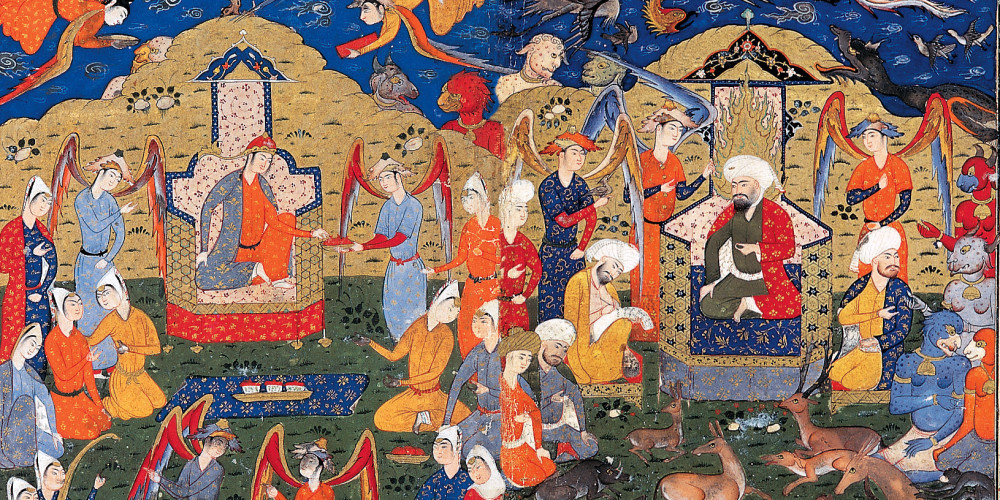
It is well known that Satan is a fallen angel whom God cursed because of his rebellion. However, the motive for his rebellion is debated among theologians. In the Quran, the devil, called Iblis, is punished for refusing out of pride to prostrate himself before Adam:
When your Lord said to the angels: “I will create a human from clay. When I have made him and breathed into him of My Spirit, then fall down in prostration to him.” So all the angels prostrated themselves, except Iblis, who was arrogant and became among the unbelievers. [Allah] said to him: “O Iblis, what prevented you from prostrating yourself to that which I created with My hands? Are you too proud or are you among the high-minded?” He replied: “I am better than him, You created me from fire and You created him from clay.” [Allah] said: “Depart from here, for you are banished, and upon you will be My curse until the Day of Recompense.” (38:71-78)
This story is related seven times in the Quran (2:30-39; 7:11-24; 15:26-43; 17:61-65; 18:50-51; 20:115-124; 38:71-85). An initial question arises: why would Allah command the angels to prostrate before someone other than Himself, namely a mere creature? Does this not create a certain tension with the idea of pure monotheism? As we will see, things become much clearer in light of the Syriac texts that inspired the Quran.
Iblis and al-Shaytan
Before getting to the heart of the matter, let us first consider the names given to the devil in the Quran. He is indeed called sometimes Iblis (from Greek diabolos) and sometimes al-Shaytan
1. More precisely, the name Iblis appears in scenes that take place
before his expulsion. It is only after being expelled that the devil is called al-Shaytan
. However, the Quran does not explain the reason for this sudden change. As is often the case, the explanation must be sought in Jewish and Christian writings that underpin the Quranic narrative. The idea that the devil changed names after his expulsion has been suggested by several Syriac theologians of antiquity, for whom “the devil chose this name after disobeying God's command to worship Adam”
2. In the
Cave of Treasures, a Syriac text composed around 600
3,
it is recounted that after disobeying, “he was called by the name of Satana, because he had turned away”
4.
The Fall of Iblis
The Bible states that Satan was punished by God because of his pride (Isaiah 14:12-15), but the text does not specify the exact nature of his rebellion, leaving room for various interpretations by Jewish and Christian exegesists. These theological debates have led to two main interpretations. The first, of Jewish origin, argues that Satan wanted to be worshiped as a god and to rule over the world. It remains the prevailing explanation among Jews and Christians today
5. However, the second interpretation will be our focus here: according to it, the devil was cursed for refusing to prostrate before Adam. This legend is first attested in a book titled
The Life of Adam and Eve, composed in the 5th or 6th century. It contains the following passage:
Lamenting, the devil said: “Adam, all my hostility, resentment, and jealousy are directed toward you, because of you I have been banished and deprived of my glory, which I had in heaven, amid the angels. Because of you, I was expelled to the Earth.” Adam replied: “What have I done to you? What fault have I committed against you? Since we have neither harmed nor injured you, why do you persecute us?” The devil answered: “Adam, what are you telling me? Because of you I was expelled from heaven. When you were formed, I was banished from the face of God and cast out from the company of the angels. When God breathed into you His spirit (spiritus) of Life, and your face and likeness were made in the image of God, Michael came to you so that I might worship you before the sight of God, and the Lord God said: ‘Behold, Adam, I have made him in Our image and likeness’.” [The angel] Michael called all the angels and said: “Worship the image of the Lord God, as the Lord God commanded you.” And Michael worshiped first, called me, and said: worship the image of Yahweh. I replied: “I was not made to worship Adam [...]. I will not worship what is inferior and subordinate to me. I am before this creature. Before it was formed, I had already been formed. It is to be worshiped by it, not me.”
It is noticeable that the Quran closely follows the legend’s outline: i) God creates Adam by breathing His Spirit into him; ii) He commands the angels to prostrate before Adam; iii) the angels comply except for Satan; iv) Satan is expelled from paradise. However, a difference between the two texts should be noted: whereas in
The Life of Adam and Eve, the devil refuses to prostrate before Adam on the grounds that he was created
before him, in the Quran, the devil invokes a completely different argument, namely that he was created from fire, a nobler substance than the clay from which Adam is made. This same argument appears in other Christian texts, notably in <Questions of Barthélemy> or the
Cave of Treasures, already mentioned. In the latter, it is written:
When the leader of the lower order (= the devil) saw how great was given to Adam, he became jealous and refused to prostrate himself before him with the angels, and he said to his peers: “Do not prostrate yourselves with the angels, and do not praise him. The right thing is that he prostrates himself before me, who am fire and spirit, and not that I prostrate myself before dust, which was shaped from fine dust.” When the rebel and disobedient decided this of his own free will, he separated himself from God. He was cast down and fell along with all his host (
Cave of Treasures, 3:1-4).
The Reasons for Prostration
Let us return now to the question we left hanging: why does God command the angels to prostrate before a creature? For Christians who propagated this legend, it was nothing embarrassing. On the one hand, in the Bible, Adam is created in the image of God (Genesis 1:27), a point on which the Quran remains silent
6. On the other hand, Adam is considered in Christian exegesis as a prefiguration of Jesus
7. Thus, by prostrating before Adam, the angels are actually prostrating before Jesus. This anticipates Hebrews 1:6 where the angels bow before him: “And let all the angels of God worship him!” For Christians, the angels' prostration before Adam makes perfect sense: it confirms Jesus’ divinity, seen as the “new Adam”. The story of the prostration only truly makes sense within a Christian perspective, where Jesus is both God and the new Adam. Conversely, it becomes theologically incoherent in the Quran, which rejects the divinity of Jesus and advocates a “pure monotheism”. It is likely that the scribes responsible for the final compilation of the Quran were aware of the theological tension created by this story. As mentioned earlier, this story appears seven times in the Quran. A German historian, Karl-Friedrich Pohlmann, has shown that these different versions result from the work of multiple editors. In particular, the more recent versions aim to correct and “de-Christianize” the earlier versions, to make them more conform to the Quranic theology that their authors sought to promote
8.
Comparison Table
Questions of Barthélemy
Satan said: “When I returned from the ends of the Earth, [the angel] Michael said to me: ‘
Prostrate yourself before the image of God [Adam], which He formed in His likeness.’ But I replied: ‘
I, who am fire from fire, should prostrate myself before clay and matter?’ [...]
Then God became angry with me and cast me down” (4:55-56).
Quran
Allah said: “
What prevents you from prostrating when I command you?” He said: “I am better than him [Adam],
You created me from fire and You created him from clay.” Allah said: “
Descend from here; you have no right to be arrogant in this place, go out” (7:12-13).