Introduction
The Quran repeatedly speaks of a “barrier” (barzakh) separating the “two seas”: “He has let free the two seas to meet; there is a barrier between them which they do not transgress” (55:19-20); “And it is He who lets free the two seas: one sweet, refreshing, the other salty, bitter. And He has placed between them a barrier and a forbidding partition” (25:53), etc. These verses have been interpreted by contemporary Muslim apologetics as evidence of a “scientific miracle.” Indeed, they seem to refer to a marine phenomenon where two seas meet without mixing – at least in appearance. Some have gone so far as to claim that the explorer Jacques-Yves Cousteau, who studied the phenomenon, converted to Islam. The rumor, although entirely unfounded and repeatedly denied by the family of the individual concerned, nonetheless serves a certain narrative aiming to prove the miraculous and scientific character of the Quran. In this article, we will examine the claim that the Quranic passages about the “two seas” align with scientific data and constitute a miracle. We will see that these texts more likely refer to an ancient Sumerian cosmogonic myth.A marine phenomenon?
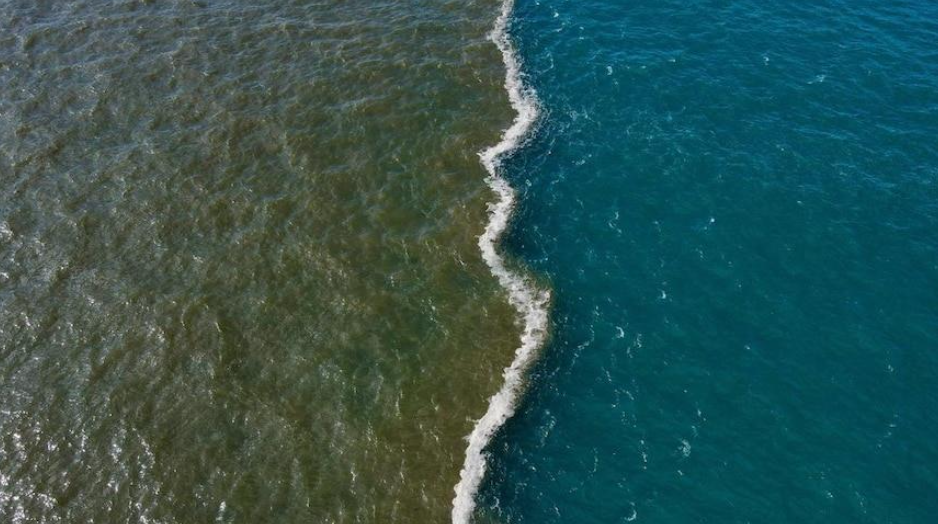
At first glance, these passages raise several questions: what are these “two seas”? Where are they located? And what does the “impossible barrier” that is supposed to separate them refer to? According to some exegeses, the Quran describes a natural phenomenon occurring in estuaries, when freshwater flows into saltwater from the sea or ocean. Due to their different salt densities, these two waters do not mix instantaneously, and the freshwater, being lighter, floats on the saltwater, which can visually give the impression of a sort of “barrier” between them – to use the technical term, it is a halocline.
However, the hypothesis of the “scientific miracle” does not withstand critical scrutiny. Even if we admit that the Quranic verses refer to this specific phenomenon, they only offer a simple empirical description. The fact that waters do not mix at the surface is indeed observable by everyone. Moreover, numerous examples of such observations have been recorded in antiquity. Rabbi Jonah was already marveling in the 4th century that “the Jordan passes into the Sea of Tiberias without mixing” (Bereshit Rabbah 4:4). A naive observer might deduce that an invisible barrier prevents the two water flows from mixing, but this is a misunderstanding. In fact, the “non-mixing” is only observable at the surface. Underneath, waters do mix more or less rapidly below the surface1 . In other words, the Quran describes an observable phenomenon but interprets it incorrectly by asserting the existence of a “barrier” separating the two watercourses. Additionally, the phenomenon is often temporary and can be affected by many factors such as tides, wind, or internal friction which “can reduce or eliminate the stratification of density in the water column,” as noted by Michael J. Kennish 2 .
At most, one could credit the Quran with some knowledge if it explained how this phenomenon occurs. This was already known by ancient authors like Aristotle, who wrote in the 4th century BCE: “What makes the sea seem to be a place, is that the salty part remains there because of its weight, while the sweet and drinkable part rises because of its lightness” (Meteorologica, II, 2). Pliny the Elder (d. 79) also noted: “Freshwaters float above the waters of the sea, undoubtedly due to their greater lightness” (Natural History, II, 106). The Quran, on the other hand, makes no mention of this matter.
A cosmogonic myth
We will now see that the passages in the Quran mentioning the “two seas” that do not mix are not referring to the marine phenomenon of haloclines but to a cosmological representation of Sumerian origin3 . In fact, the inhabitants of the ancient Near East believed that the sky was a vast expanse of water, which explained its blue color and the rain that falls from it. Hence, there would be two seas: one sweet, the sky, and the other salty, the terrestrial seas and oceans4 . This conception is also present in biblical texts. For example, in the book of Genesis, we read: God said: “Let there be a firmament in the midst of the waters, and let it divide the waters from the waters.” And God made the firmament, and divided the waters which were under the firmament from the waters which were above the firmament5 , where we see: “You have set a boundary that the waters may not pass, so that they do not cover the earth again” (Psalms 104:9). The “boundary” which waters may not pass strongly resembles the “barrier” mentioned in the Quran – a barrier whose role is precisely to prevent waters from crossing their boundary and mixing. The theme of two waters remaining separated by an impassable boundary is also well attested in rabbinic and Syriac writings, some of which may have directly or indirectly influenced the Quran6 . The various Quranic passages mentioning the “two seas” thus seem to fit into the continuity of mythological representations of the ancient Near East. Classical Muslim commentators also interpreted the text in this way. Al-Qurtubi (d. 1273) reports in his Tafsir: Ibn Abbas and Ibn Jubayr said: It refers to the ocean of the sky and the ocean of the earth. Ibn Abbas added: They meet every year, and between them is a barrier decreed by Allah. “And there is a barrier between them which is forbidden to be transgressed.” It is forbidden for the salty water to mix with the fresh water or for the fresh water to become salty.This seems decisively confirmed by a detail from Surah 18, where Moses goes in search of the “confluence of the two seas” (18:60). Historians have noted similarities between this story and the Epic of Gilgamesh. In the Sumerian myth, the hero Utnapishtim lives “at the mouth of the rivers” (Tablet 11, v. 195). Tommaso Tesei explains that this confluence is “the place where the celestial and terrestrial oceans meet and through which fresh waters reach the land via an underground passage”7 . Furthermore, in the Quran, the servant says to Moses: “When we took refuge near the rock, do you see, I forgot the fish.” Apparently, then, there is a rock near the “confluence of the two seas.” Now, in Mesopotamian texts, references are often made to a mountain located “at the sources of the two rivers, in the middle of the canals of the two abysses”8 . The rock in the Quran, near the “confluence of the two seas,” clearly echoes the motif of the mythic mountain in Mesopotamian texts located “at the sources of the two rivers,” where celestial waters join terrestrial waters9 . It is *not* intended here to claim that the authors of the Quran had *direct* knowledge of these texts. Rather, an intermediation through Jewish and/or Syriac texts should be considered. The theme of the cosmic mountain is indeed well represented in Syriac-origin writings10 , which are the likely source of the Quran.