Introduction
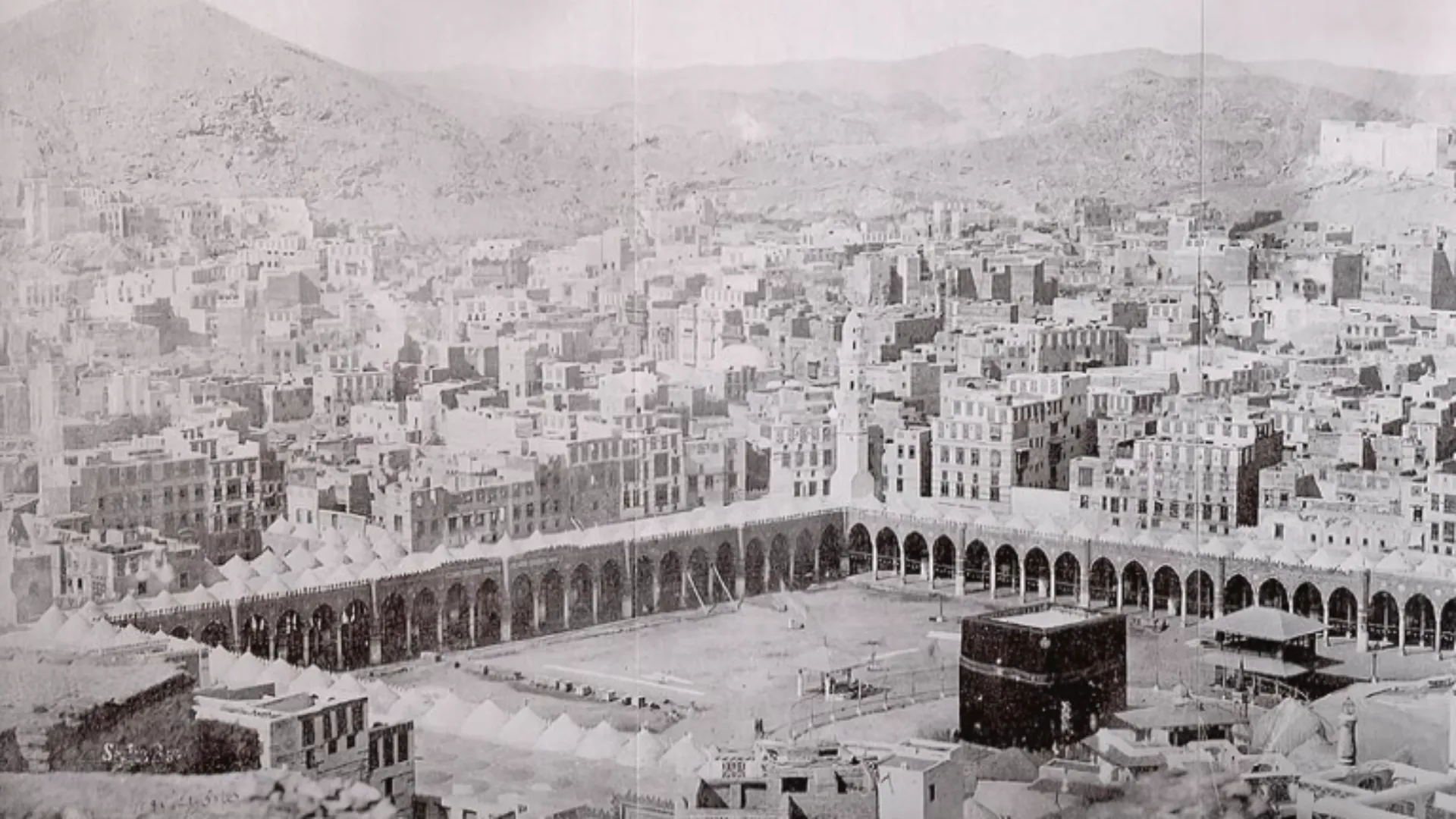
Medina is a sacred city for Muslims, on the same level as Mecca. According to Islamic tradition, the Prophet chose the oasis as the place of his emigration: it is the hijra, which marks an important milestone in the development of the new religion. This history is well known, even if many points remain to be clarified. What interests us in this article is the history of Medina before Islam. We will now refer to it as "Yathrib," the ancient name by which the oasis was known. It should be noted in this regard that the spelling of this name seems uncertain. Arab sources mention Athrib, Athârib, or Yathrib, and pre-Islamic sources provide other variants (see the discussion below). It is only at a later time that the name Medina (in Arabic "al-Madinah") became established. According to Islamic tradition, this name would be the diminutive of the toponym Madînat al-nabî ("the city of the Prophet"), of which only the first term was retained out of habit. This explanation of the etymology of the name seems unlikely 1 and we will see further on that other hypotheses need to be explored.
Beyond the etymological problem posed by the name(s) of Yathrib/Medina, several questions can be asked: are there pre-Islamic sources that mention the locality? What do we know about the history of Yathrib before Islam? Who were its inhabitants? What was its economy based on? etc. This article will provide answers to these questions.
Pre-Islamic sources?
Unlike Mecca, whose name does not appear in any sources prior to Islam2 , Yathrib appears in several pre-Islamic documents. One of these documents is an inscription from the last Babylonian king Nabonidus dating from the 6th century BCE. The inscription, discovered in Harran, in Northern Mesopotamia, mentions a list of localities traveled through by the Babylonian ruler, which includes the name "Iatribu." It reads: […] But I myself withdrew far from my city of Babylon, (on) the route of Temâ, Dadânu, Padaku[a], Ḫ ibra, Iadiḫ u, and up to Iatribu; for ten years I lived among them, and I did not return to my city of Babylon…3If the toponym "Iatribu" does indeed correspond to Yathrib, then here we have the earliest mention of the oasis, which, according to the inscription, would have been part of Nabonidus' conquests. However, Alfred-Louis de Prémare rightly recalls that "the name YTRB was borne by other localities in the Peninsula" 4 . He adds that the name mentioned in the inscription "makes us think more of oasis areas located in the north of the Arabian Peninsula, a place of expedition for King Nabonidus before his return to Mesopotamia to rebuild, in Harran, the Moon God’s temple. We cannot easily go so far as to affirm that it referred to the locality that will be discussed twelve centuries later, at the beginning of Islam" 5 .
Another inscription more certainly references Yathrib. It is a inscription from the 3rd century BCE discovered at Qarnâ, the capital of the Minyan kingdom, located north of present-day Yemen. It mentions two women from a locality called "Yatribu" 6 . The Greek geographer Ptolemy (d. ~ 168), author of a map of ancient Arabia, also mentions the toponym "Lathrippa" (λαθριππα), which historians traditionally identify with Yathrib/Medina. Even more interesting is the South Arabian inscription Murayghân 3, written around 550, a few decades before Muhammad’s birth. The inscription is made by (or on behalf of) Abraha, the Yemeni ruler of Ethiopian origin, who launched, around the mid-6th century, a series of expeditions in central Arabia. In this text, Abraha celebrates his victories over several cities, among which the name of Yathrib appears again: King Abraha Zybmn, king of Saba’, of Dhû-Raydân, of Ḫ aḍ ramawt and Yamnat, and his Arabs from the Highlands and the Coast, wrote this inscription when he returned from the Land of Maʿadd, […] and seized all Arabs of Maʿadd, Halgar-et-Khatt, Tayy, Yathrib, and Guzâ 7 . Finally, one cannot help but be struck by the marginal place that the cities of Mecca and Yathrib occupy in the Quran, as their names only appear once. Yathrib is explicitly mentioned by name in Surah 33, "The Confederates," which clearly contextualizes a military scenario. It refers to the "People of Yathrib" who are criticized for staying in their homes instead of fighting. It reads: "A group of them asked the Prophet for permission to leave, saying: ‘Our homes are unprotected,’ though they were not: they only wished to flee" (33:13). The Quran provides no details about the event in question (exegeses usually refer to the Battle of the Trench), and it seems that there is a "mark of a later writer" 8 . Furthermore, other verses mention "al-Madinah," but it is sometimes difficult to determine whether the term is a proper noun referring explicitly to Medina or a common noun designating "the city" in a general sense.
Population and economy
Very little is known about the history of Yathrib before Islam. The inscriptions we mentioned provide too little information, and we are essentially entirely dependent on later Islamic sources. According to these, the oasis was inhabited by about a dozen tribes, among which were Jews and polytheists. We can thus speak of a mixed population. The polytheists of Yathrib were linked to two tribal groups, the Aws and the Khazraj, who were the true rulers of the city.
Regarding the Jewish tribes, there would have been three: Banu al-Nadir, Banu Qurayza, and Banu Qaynuqa. Several questions initially arise: are they exiled Jews or Arab converts? Did they practice “orthodox” Judaism or were they part of a minority movement? Haggai Mazuz attempted to answer this last question in a book titled The Religious and Spiritual Life of the Jews of Medina. Reviewing Muslim sources, he concludes that “the Jews of Medina were rabbinic-talmudist Jews on almost all levels” 9 . However, the author’s conclusion does not withstand critical scrutiny. In fact, he too easily takes the sources he uses at face value, without truly questioning their historical reliability. As Ilkka Lindstedt points out, these sources are “unreliable and unusable for studying the religious nature and identity of the Jews of Medina” 10 . The difficulty is heightened by the fact that all our information comes exclusively from the Islamic corpus.
In this regard, it is striking that no Jewish or Christian source mentions the Jews of Yathrib. Even more striking is the fact that they left no trace behind, despite the significant wealth attributed to them in Islamic sources. Robert Hoyland notes, cautiously, that “no unquestionably Jewish inscription has yet been discovered at Mecca, Yathrib, or Khaybar, despite numerous epigraphic excavations conducted at these sites” 11 . Should we conclude that there were no Jews in Yathrib at the time of the Prophet or even earlier? If so, one must ask what interest the Muslim historians had in imagining Jewish tribes in Yathrib and fabricating stories about them. A plausible hypothesis is that these stories stem from an historicization of the Qur'an, aiming to provide a context—fictitious in this case—for the Qur'anic polemics against the Jews12 . However, there is no need to push skepticism that far. The absence of proof is rarely proof of absence, and it is hard to see how Muslim historians could have written so extensively about the Jews of Medina without at least a tiny core of historical truth, even if it is as small as a grain of sand. Overall, despite the disturbing silence of the sources, it seems very probable, and consistent with data collected elsewhere in the Arabian Peninsula, that the oasis of Yathrib was inhabited by Jewish tribes.
One thing is certain: these populations lived dispersed within isolated settlement islands. Indeed, Yathrib was not a "city" in the proper sense, but a collection of small more or less spaced-out groups. Most of these settlements housed just a few dozen inhabitants, and the population of the oasis did not exceed a thousand inhabitants 13 . Their dwellings were probably made from volcanic rocks abundant in the region. In addition to traditional houses, there was a system of fortifications consisting of watchtowers called âtâm (plural: utum). The Medinan scholar and journalist Abd al-Quddus al-Ansari (d. 1983) claims to have photographed several buildings dating back to the pre-Islamic period of Yathrib. In the absence of archaeological excavations, it is, however, difficult to determine whether these remains are equally old. As Geoffrey R. D. King writes: The archaeology problem in Yathrib/Medina is identical to that of Mecca. Central Medina underwent massive reconstruction in recent years, with the Mosque of the Prophet and its surroundings having been rebuilt and expanded. Many surface archaeological remains, whatever they were, have been eradicated as a result. The efforts of a Saudi colleague to record stratigraphy (exposed during road works or excavations for construction) have failed due to restrictions14 .
King also emphasizes the absence of walls around Yathrib, which, in his view, testifies to the political situation of the oasis, which lacked a central authority capable of locating large-scale infrastructure.
Yathrib’s economy was mainly based on date cultivation, which is not surprising for an oasis. It is also said that there were several gold and silver mines in the vicinity of Yathrib, notably at the ancient site of Maʿdin Banī Sulaym – now Mahd al-Dhahab. According to Islamic tradition, the Jewish tribe of Banu al-Nadir had three hundred miners working in these mines at the time of the Prophet15 . However, archaeological data do not align with the chronology provided by Muslim traditionists. Archaeologists have shown that the Mahd al-Dhahab mine was active during the 10th century BCE but that its exploitation ceased for a long period before resuming during the Abbasid era16 .
Furthermore, trade does not seem to have been practiced on a large scale by the inhabitants of the oasis. Sure, unlike Mecca, Yathrib was near the trade routes of the time, but their use had already begun to decline several centuries before Islam. Alessandro de Maigret explains that: this route - better known as the "Incense Caravan Route" - was used until the advent of Islam, but its usage diminished from the first century CE, when the discovery of the monsoon regime (by the Greek navigator Hyppalus, apparently) led to the opening of a maritime route via the Red Sea17 . In the end, Yathrib seems to have been a relatively marginal locality both demographically and in terms of its economic and political weight in pre-Islamic Arabia.
A curious change of toponym
Following the emigration (hijra) of the Prophet and his Companions to the oasis, Yathrib lost its ancient name and was called now al-Madinah, meaning literally "the city." However, this change of name raises significant questions. First, it is quite curious to rename a city simply as "the city" 18 . One may wonder if, as the Muslim tradition suggests, the name Medina indeed derives from the Arabic "al-Madinah," or if another etymology should be sought. This latter hypothesis is suggested by a Syriac chronicle written around 660, where the author narrates the early Muslim conquests. We read: […] as well as Medina, named after Madian, the fourth son of Abraham through Qetoura, who is also called Yathrib [...]19 .As seen, the author of the chronicle links the name of Medina with that of Madian, who appears in the Bible as one of the sons of Abraham and his second wife Qetoura20 . According to tradition, his descendants formed the Midianite people, who settled north of the Arabian Peninsula. For the author of the Apocalypse of Pseudo-Matthew, writing in the early 8th century, it was clear that the Arabs of his time, whose swift expansion across the Near East he describes, were none other than these Midianites21 .
Secondly, a number of accounts within the Islamic tradition dismiss the use of the name Yathrib. Ahmad ibn Hanbal (d. 855) reports in his Musnad a strange hadith in which Muhammad allegedly declared: "He who calls al-Madinah Yathrib, let him ask forgiveness from Allah: it is Tâbah! it is Tâbah!" 22 . These words are even more curious since the Quran, as mentioned, explicitly mentions Yathrib. Moreover, the meaning of "Tâbah," repeated twice in the hadith, is far from clear, and scholars’ interpretations vary considerably. Prémare notes that several localities bore a very similar name: Tâb, in Bahrain, or Tayba (or Tayyibah) in Palestine23 . Jan Van Reeth sees it as a reference to the biblical place Tôb, located near Bosra, in Syria24 . All these elements cast doubt on the exact location of Yathrib/Medina, leading some historians to suggest a location in the northern part of the Arabian Peninsula25 .