Context
The Quran repeatedly recounts the fate of certain Jews who disobeyed divine commandments. Allah punished them in a rather peculiar way by transforming them into monkeys and pigs:
When they disobeyed what had been forbidden to them, We said to them: “Be despised monkeys!” (7:166).
Indeed, you know those among you who transgressed the Sabbath; We said to them: “Be despised monkeys!” (2:65).
Those whom Allah cursed, against whom He was wrathful, and who He made into monkeys and pigs […] (5:60).
The first question that arises is whether these passages should be interpreted as a metaphor or literally. The vast majority of Muslim exegeses have favored the latter option, namely that the Jews in question were physically transformed into beasts1. In his Tafsîr, the famous commentator al-Tabari (d. 923) reports that the Jews turned into monkeys for transgressing the Sabbath lived in a village situated by the Red Sea2. Ibn Kathir (d. 1373) drew the following conclusion:
Allah made these inhabitants who suffered ignominious and debasing punishment an example for their contemporaries and descendants […]. This punishment was cited by showing its causes so that men might reflect, fear Allah, and take a lesson and warning. So let them fear what might happen to them if they disobey Allah3.
According to most Muslim commentators, the transformation of men into animals is therefore a historical event that could happen again to punish the unbelievers. Indeed, this is the meaning of the Quranic text, which typically uses examples of past punishments as threats to its contemporaries. As we will see, these stories of Jews transformed into monkeys derive from Jewish legends and Greek mythology.
Mythological origins
The idea that men punished by a deity are transformed into animals is not new. It is indeed a classic theme in ancient myths, and examples “abound in the folklore and mythology of virtually all ethnicities and peoples of the world”
4. In Greek and Roman mythology, this fate is usually reserved for men who have misbehaved towards the gods
5. For example, the formidable sorceress Circe transformed Ulysses’ crew into pigs, or the case of Actaeon, who was turned into a stag by the goddess of the hunt, Diana, for having looked at her during her bath.As Adam Silverstein notes, “on the eve of Islam, well-known stories circulated in the Levant describing divine punishment of sinners through their transformation into animals […]”
6. The passages in the Quran about the metamorphosis of Jews into animals are thus situated within the mythological conception where a deity punishes humans by transforming them into animals.
Men and monkeys
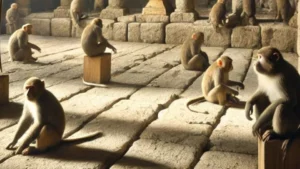
According to Quranic mythology, Allah transformed transgressors into monkeys. The choice of this animal is not accidental. In ancient mentalities, the monkey had a bad reputation. It was seen as the “accursed beast” par excellence. It was viewed as a grotesque caricature of humans because of the resemblance between the two species. In Christian iconography, the monkey was often a symbol of the devil, a conception that probably dates back to ancient Egypt
7. Therefore, it is not surprising that the transgressors are specifically transformed into monkeys and not, say, into warthogs or camels. Moreover, transformation into a monkey frequently appears in Talmudic legends as punishment for men who incurred God's wrath. The Babylonian Talmud, for instance, recounts that during the time of the Tower of Babel, men who wished to worship idols were transformed into monkeys (
Sanhedrin 109a)
8. In another story, it is said that shortly before the flood, men fell into sin; for this reason, their faces resembled that of a monkey
9.
A Talmudic legend
Let us now return to the Quranic story of the transformation of Jews into monkeys. This punishment was inflicted upon them because they transgressed the Sabbath. We read: “Ask them about the city situated beside the sea. Its inhabitants neglected the Sabbath, when fish appeared to them on that day at the surface of the water, although they did not come outside the Sabbath. We tested them thus because they were wicked” (7:163). It is understood that this group of Jews lived near the sea, and that they sinned by catching fish on the Sabbath despite the prohibition. Two stories in the Bible show some similarities. (1) In the time of the manna pouring in the desert, God sent manna, a miraculous food that the Hebrews had to gather every day except on the Sabbath. However, some Jews transgressed this prohibition by gathering manna on the Sabbath (Exodus 16:23-28). (2) The other story concerns a man who gathered sticks in the desert on the Sabbath. To punish him, God ordered his stoning (Numbers 15:35).
However, these two episodes differ from the Quranic story which speaks of Jews who sinned by catching fish on the Sabbath. This story does not appear in the Bible but in a post-Talmudic legend. The Talmud recounts that some Jews sinned by catching fish in a pit on the Sabbath and were destroyed by God as punishment
10. As seen, the Quranic passage is a slightly modified version of the legend where the Jews, instead of being simply destroyed by God, are transformed into monkeys—a punishment well attested in the Talmud, as we have seen. In other words, the Quran combines several Talmudic-origin stories: on the one hand, the episode of the Jews transgressors who broke the prohibition of sinning on the Sabbath; on the other, that of men who disobey God's commandments and are transformed into monkeys
11.
Comments (0)
No comments yet. Be the first to respond.
Comment
We'd love to hear your thoughts on this article!