Context
According to the Gospels, Jesus was born in a manger in Bethlehem, near Jerusalem
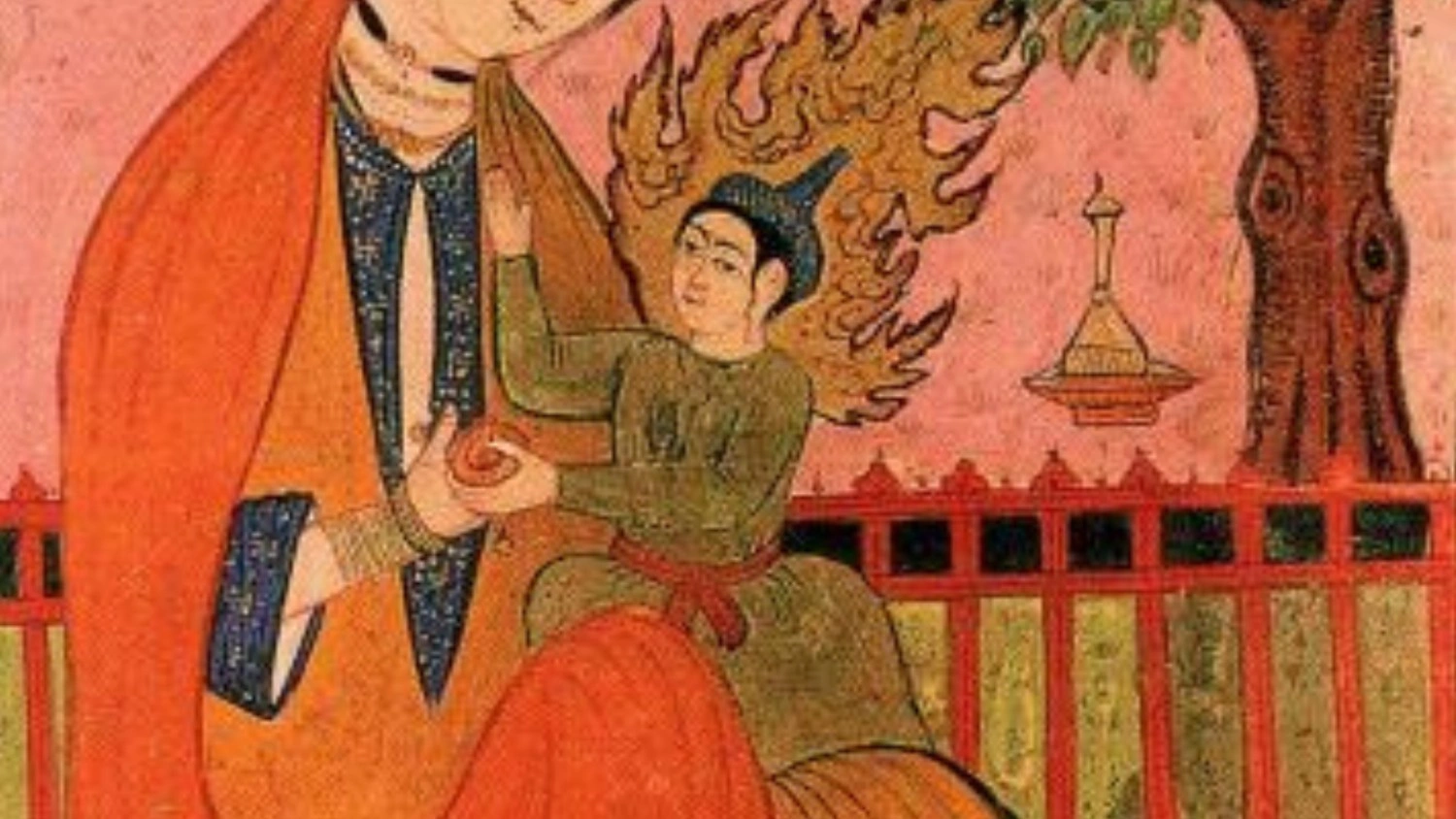
1. But the Quran presents a very different version of the story, where Mary withdraws "to a distant place" to give birth to Jesus under a palm tree:
She became pregnant with the child and then withdrew with him to a distant place. The pains caught her near the trunk of the palm tree. She said: “Misfortune to me! Would I had died long before, forgotten and out of sight!” The child who was at her feet called to her: “Do not grieve! Your Lord has made a stream flow at your feet. Shake the trunk of the palm tree towards you; it will drop ripe, fresh dates upon you. Eat, drink, and be comforted.” (19:22-25).
How to explain this difference? As we will see, the Quran draws inspiration from several legends rooted in Greek mythology.
The Quran and the myth of Apollo
The story of Jesus' birth in the Quran is quite similar, at least in broad outline, to that of the birth of Apollo. In Greek mythology, Leto, the mother of Apollo, seeks refuge under a palm tree near a river to give birth to her son
2. Comparing the two stories, Suleiman Mourad notes that the Quranic version was an "obvious reworking of Leto’s birth in Greek tradition"
3. It is true that in both cases, we are dealing with a pregnant woman searching for a secluded place, lying under a palm tree at the edge of a river, then giving birth to a sacred child. However, it is unlikely that the myth of Apollo is the *direct* source of the Quranic passage
4. In the Orient, the palm tree is a very common tree, and in pre-Islamic times, it was associated with femininity and spiritual fertility
5. The story of the palm tree in the Quran thus seems to stem more from the Near Eastern cultural universe of the time.
The version of the apocryphal texts
However, there are several similarities between the Quranic account and certain legends found in apocryphal gospels. First, the
Protoevangelium of James, a 2nd-century apocryphal text, recounts that Mary gave birth somewhere in the desert
6, which explains the “distant place” mentioned in the Quran
7. Additionally, the story of the palm tree appears in Christian legends dating back “at least to the early fifth century,” as noted by Stephen Shoemaker, who also indicates that the legend "circulated widely in the Near East before Islam"
8. For example, in the Gospel of Pseudo-Matthew, we read:
And after Mary sat [under the palm tree], raising her eyes to the foliage of the palm, she saw that it was loaded with fruit, and she said: “Oh, that I could taste the fruit of this palm.” And Joseph said to her: “I wonder why you are saying that, while you see how high this palm is. You are thinking of its fruit, but I am thinking of the water that is already lacking in our bottles, and we have no way to fill and quench our thirst.” Then, the little child Jesus, sitting on his mother’s lap, cried out and said to the palm tree: “Tree, bow down and restore my mother with your fruits.” Immediately, upon this word, the palm tree bowed its head to Mary’s feet, and after gathering the fruits they carried, all were refreshed.
9
However, there is an important difference between the story in Pseudo-Matthew and the Quranic version. Whereas here, the story of the palm tree takes place during the flight into Egypt, in the Quran, it occurs at the time of
the birth of Jesus. In other words, the Quran appears to have “fused” two originally separate stories: that of Jesus' birth and that of the palm tree. It should be noted that this “fusion” of the two stories is not unique to the Quran; it originates from traditions associated with a Palestinian church (known as the church of Kathisma, the “Seat of Mary”) that the proto-Muslims
10 visited around the time of the conquests (archaeological excavations indeed show that the church was at least partially transformed into a mosque). Many historians have hypothesized, quite plausibly, that the story of Jesus' birth in the Quran was composed during the conquests when the proto-Muslims discovered the traditions of the church of Kathisma and incorporated them into the Quranic text, which was still being developed
11. So, in effect, this could be an example of a passage added to the Quran
after the Prophet's death.
Conclusion
We have reviewed the various sources that may have influenced the Quranic account of Jesus' birth. The legend of Apollo shows interesting similarities with the Quran, but if influence there was, it seems to have been rather indirect. Indeed, Angelika Neuwirth notes that the story of the palm tree in the Gospel of pseudo-Matthew itself is a “reworking” of the Greek legend, which “found its way, in a concise form, into the Quranic text”
12. In this case, we can consider the transmission of the legend as follows: legend of Apollo (Greek mythology) ➔ Gospel of Pseudo-Matthew ➔ Quran. To complicate matters further, the Quranic account is not exactly identical to that found in the Gospel of Pseudo-Matthew but shares more similarities with an original Palestinian version from the church of Kathisma. Ultimately, the story of Jesus’ Nativity in the Quran is a kind of “patchwork” made from several legends circulating in antiquity.