Context
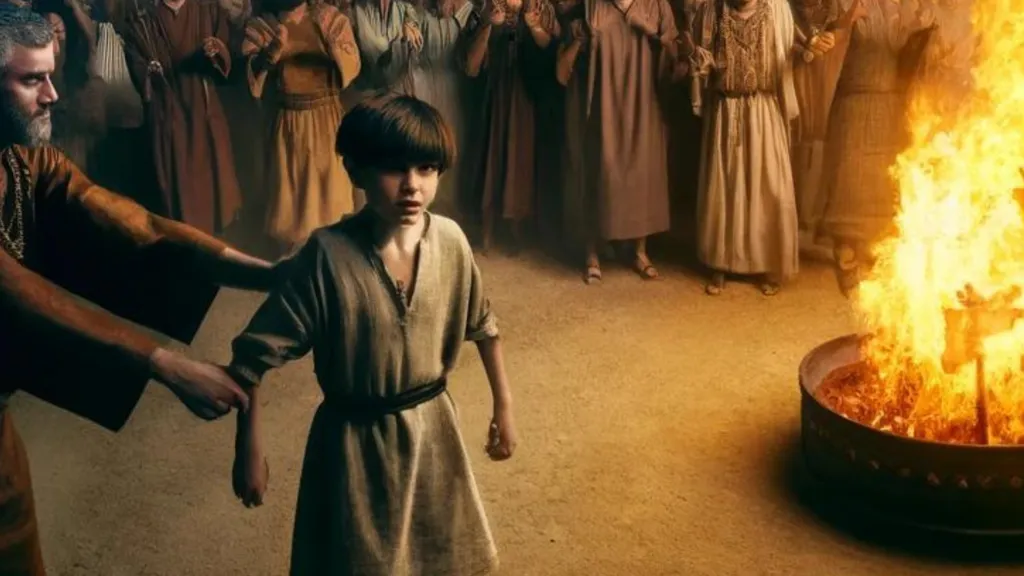
The Quran recounts a story in which young Abraham is thrown into a furnace by the people of his community because he had abandoned idolatry to turn towards the one God, but he nevertheless emerges unharmed from the flames: "The only response of Abraham's people was to say: 'Kill him or burn him'." But God saved him from the fire. This is indeed a sign for those who believe" (29:24, see also 37:97). As we will see, this story, which is not found in the Bible, actually derives from a Jewish legend.
A Jewish Legend
The legend is attested for the first time in the
Book of Biblical Antiquities, the author of which is not known with certainty, although the text has been (incorrectly) attributed to Philo of Alexandria. Nevertheless, there is a "general consensus" among historians regarding its dating, which they place between 50 and 150
1. Howard Jacobson, whose study is authoritative, estimates that the text was composed no later than the mid-2nd century
2. Here is what we read in it:
They then said: "Let’s burn the one they found alone [= Abraham]." [...] They took him, built a furnace, and set it on fire. They threw into the furnace the stones which were burned by the fire. And then Prince Iectan, more dead than alive, took Abram and threw him with the bricks into the fiery furnace. [...] But Abram felt not the slightest injury within the embattlement. And Abram rose from the furnace; the fiery furnace fell. Abram was saved [...] (
Biblical Antiquities, VI, 15-18).
The legend is then retold in some rabbinic commentaries like
Genesis Rabbah, a 5th-century exegesis book
3. The text reports a slightly different version of the legend, where a dispute breaks out between Nimrod and Abraham to determine which of the two worships the true God. In the end, Nimrod decides to throw Abraham into the furnace to see if his God would help him, which indeed happens (
Genesis Rabbah, 38:13).
Let us emphasize that the legend originated from a pun in the Bible. In the Book of Genesis, God speaks to Abraham thus: "I am the Lord who brought you out of Ur of the Chaldeans to give you this land as your possession" (Genesis 15:7). The name of Abraham’s hometown, Ur, is phonetically close to the Hebrew term for fire, “’or.” Thus, one could read the verse as: "I am the Lord who brought you out
of the fire of the Chaldeans." Based on this pun, the rabbis developed an entire legend in which God saves Abraham from the flames into which he had been thrown by his people.
The Legend among Christian Authors
Although the legend is of Jewish origin, it was also known to ancient Christian authors. Jerome of Stridon (d. 420), known for his Latin translation of the Bible, already knew the legend as well as the pun that inspired it. In his
Hebrew Questions on Genesis, he indeed writes:
Instead of these words, in the region of the Chaldeans, we read in Hebrew, in Ur Chedim, that is, in the fire of the Chaldeans. There is, concerning this point, among the Hebrews, a tradition that Abraham was delivered into the flames because he refused to worship the fire that the Chaldeans worship, and, delivered through God's aid, he escaped the fire of idolatry; it was then, as we read further, that he went to settle with his family in Haran outside Chaldea [...].
This text is of great importance because it proves not only that the legend was already known before the Quran but also its Jewish origin. We notice in the passage that Jerome does not seem to believe the legend, as shown by the use of the conditional ("Abraham
was delivered into the flames"). Saint Augustine (d. 430), who wrote around the same time as Jerome, also briefly alludes to the legend in
The City of God, where he states that "the seventy-five years of Abraham, when he left Charra, are counted from the day
he was delivered from the fire of the Chaldeans" (
The City of God, XVI, 15). Note that this passage appears in the manuscript MS XXVIII(26), discovered in Verona, northern Italy, which contains books 11 to 16 of
The City of God. The manuscript’s date is between 420 and 449
4, definitively showing that the Quran was inspired by a legend already circulating several centuries before its writing.
Zoroaster or Abraham?
While there is no doubt that the legend inspiring the Quran is of Jewish origin, it seems that it itself is based on a Zoroastrian legend. Indeed, several ancient texts recount a very similar legend in which Zoroaster, the founder of the ancient Iranian religion, is also thrown into fire by his enemies and miraculously emerges
5. The story where Abraham comes out of the flames unscathed is in a way a "remake" of the Zoroastrian legend
6. Historian Yishai Kiel explains that the Jewish version was composed at a time of intense rivalry between Jews and Zoroastrians. In antiquity, Zoroaster and Abraham, both originating from the same region, were sometimes considered the same person. In reaction to this idea, Jewish scholars rewrote the Iranian legend, but reversed the roles: Zoroaster became (through the figure of Nimrod) the tyrannical king, and Abraham, the innocent victim saved by God
7.
Comparison Table
Biblical Antiquities, VI, 15-18
Let us then burn [Abraham] [...]. And then Prince Iectan […] took Abram and cast him with the bricks into the fiery furnace. [...] But Abram felt not the slightest injury within the embasement.
And Abram rose from the furnace; the fiery furnace fell. Abram was saved.
Quran, 29:24
The only response of Abraham’s people was to say:
‘Kill him or burn him’. But God saved him from the fire. This is indeed a sign for those who believe.